What is an AIoT platform for smart buildings?
What is an AIoT platform for smart buildings? It is a governed software and integration layer that connects approved information from building systems, adds context and analytics, and helps authorized people make better-supported operating decisions. It sits between field systems such as access control, video, energy meters and sensors and the people or applications responsible for response. It does not automatically replace those systems or take ownership of every decision.
For a building owner or project team, the important question is not whether a platform uses the word AI. The useful question is whether it turns disconnected signals into a traceable workflow: a condition is detected, context is shown, an authorized person reviews it and a response is completed.
The KEYPLUS AIoT Platform follows this logic. Its public scope includes Platform AI, Video AI, Intelligent Analytics, Architecture & Governance, Flexible Deployment and Integration & MCP. Exact data models, topology, model selection, interface versions and project performance remain subject to technical evaluation.

Why do smart buildings need an AIoT platform?
A modern building already has many systems, but they often operate in separate applications. The access system knows a credential was accepted; the camera stores video; a meter records consumption; a door sensor reports a state; and an alarm platform raises an event. None of those facts is automatically a complete operational explanation.
When an operator has to open several screens, manually compare timestamps and decide which team should respond, the technical systems may be working while the operation remains slow or uncertain. An AIoT platform creates a controlled place to relate selected information to the space, equipment, schedule, user role and response responsibility.
What problems can the platform help organize?
- Reviewing an access exception with the relevant door, area, time and authorized role.
- Connecting a selected video event with a site condition or security workflow.
- Comparing energy data with building schedules, zones or operating context.
- Prioritizing sensor and alarm events so the responsible team can acknowledge and follow up.
- Giving managers a recurring view of unresolved conditions rather than isolated device notifications.
- Helping IT and integrators define interfaces, data boundaries, deployment ownership and audit requirements.
What an AIoT platform does not mean
It does not mean that every device becomes intelligent, that every signal is accurate enough for automation, or that a language model becomes the authority for a safety or security decision. Reliable integration, source-system ownership, permissions, data quality, deterministic rules and human review remain essential. A useful platform makes those boundaries clearer rather than hiding them behind a dashboard.
How is an AIoT platform different from other building systems?
Many products can be described as platforms, which makes comparison confusing. A building management system, an IoT cloud, an access-control management system and an AIoT platform may overlap, but they do not have the same role. The right choice depends on the operating problem and the systems that must remain authoritative.
| System type | Primary responsibility | Typical information | Where an AIoT platform can add value |
|---|---|---|---|
| Access-control system | Manage identities, credentials, permissions and access events. | Users, doors, readers, schedules, grants and denials. | Relate access exceptions to space, video, alarms or responsible workflows. |
| Video management system | Capture, record, retrieve and manage video streams. | Cameras, recordings, streams, events and review evidence. | Use selected visual events beside other approved operational context. |
| BMS or BAS | Monitor and control building equipment and environmental services. | HVAC, lighting, temperature, equipment states and schedules. | Connect facility context with access, energy, alarms or user workflows where interfaces are tested. |
| IoT cloud | Collect and manage device data, telemetry and basic rules. | Sensor readings, device status, gateways and automations. | Add role-aware context, cross-system analysis and governed decision support. |
| AIoT platform | Relate approved system information to context, analysis, users and actions. | Cross-domain events, operational context, analytics and review tasks. | Coordinate a defined journey without removing source-system authority. |
This does not mean an AIoT platform should replace a BMS, access system or video management system. In a well-defined architecture, those systems continue to perform their specialist functions. The AIoT layer helps the project decide which information should be shared, how it should be interpreted and who should act on it.
When is a specialist system enough?
If the requirement is one door, one camera, one meter or one control loop, a focused product or specialist management system may be the better starting point. An AIoT platform becomes more useful when several systems must be understood together, when a portfolio needs a common operating view, or when the project needs a staged path from connection to analytics and decision support.
What are the main layers of an AIoT platform?
A buyer should be able to draw the platform as understandable layers. Names may vary by supplier, but responsibilities should be visible. This prevents a project from purchasing interfaces without knowing who owns the data, decision or failure response.
| Layer | What it does | Questions to ask |
|---|---|---|
| Connected environment | Contains doors, cameras, meters, sensors, alarms, gateways and existing applications. | Which models, versions, locations, power and network conditions are included? |
| Interfaces and transport | Moves approved data or commands through APIs, events, gateways or other evaluated connections. | Which data, commands, acknowledgements, timing and failure states are tested? |
| Context and identity | Relates information to spaces, equipment, people, schedules, roles and responsibility. | Which system is authoritative, and which users may see or change the information? |
| Platform services | Stores, organizes and presents approved information according to project rules. | What are the retention, audit, separation, backup and service boundaries? |
| Analytics and AI | Applies rules, analytics or evaluated AI to selected patterns, exceptions and questions. | How are evidence, uncertainty, limitations and model changes shown? |
| Workflow and user experience | Routes results to operators, facilities, security, managers or approved tools. | Who receives the result, what action is allowed and how is completion recorded? |
Why is source-system authority important?
A platform may display an access event, but the access-control system may remain the authority for the credential and permission. A platform may summarize a meter trend, but the meter or energy system remains the source for the underlying reading. This distinction matters during disputes, outages, audits and maintenance. It also prevents a user from treating a generated explanation as if it were the original record.
What should the data flow look like?
A practical flow is: a field condition is produced; a supported interface transports the signal; source and timestamp are preserved; the platform adds context; a rule, analytic or AI capability produces a labeled result; an authorized user reviews it; an approved action is taken; and the outcome is recorded. Each step needs an owner and failure behavior.
Which building systems can connect to an AIoT platform?
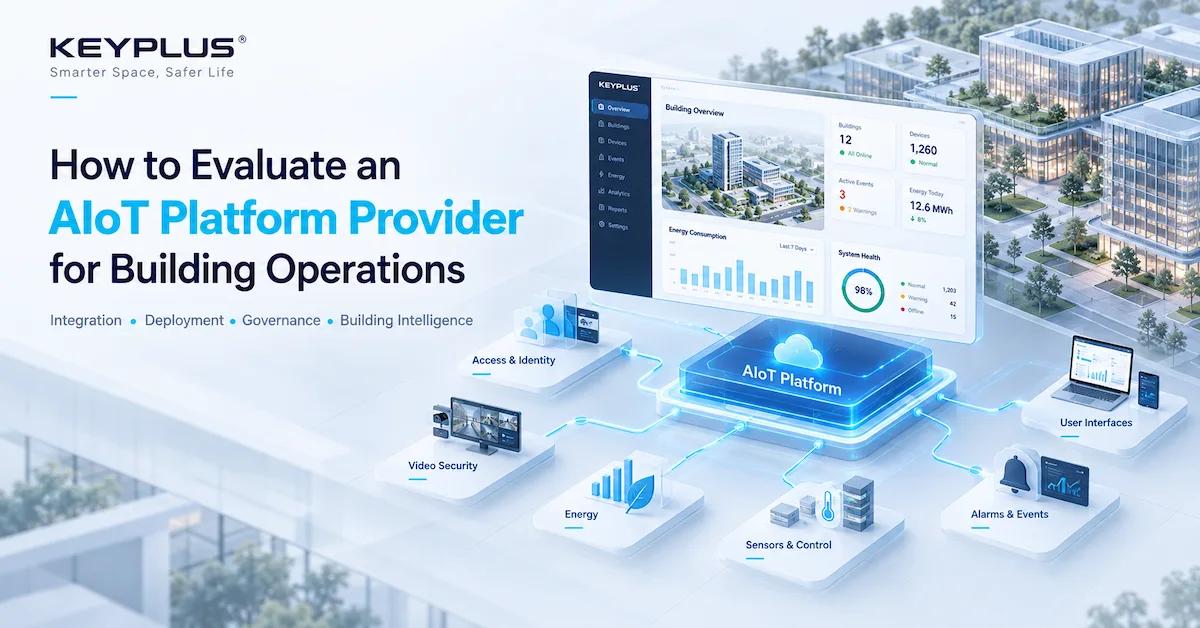
Connection should be planned around a real operating journey, not a universal device list. KEYPLUS groups connected operations into Video Security, Access & Identity, Parking, Energy, Sensors & Control, Alarm & Events and User Interfaces. The combination depends on the building, existing equipment, network, roles and outcome.
| System domain | Example question | Useful context to add | Commercial page |
|---|---|---|---|
| Access & Identity | Who is permitted to enter this area, and why was access denied? | Door, credential, user role, schedule, area and related event. | Access & Identity |
| Video Security | Which visual condition requires authorized review? | Camera, time, zone, event type, access context and response role. | Video Security |
| Energy | Where is consumption different from expected operation? | Meter, building zone, schedule, occupancy context and responsible team. | Energy |
| Sensors & Control | Which condition needs attention or an approved control action? | Sensor type, location, threshold, device status and recovery. | Sensors & Control |
| Alarm & Events | Which events should be prioritized and acknowledged? | Severity, source, owner, acknowledgement, escalation and completion. | Alarm & Events |
| Parking | Which vehicle or entry event needs follow-up? | Recognition, permission, barrier state, space and site record. | Parking |
| User Interfaces | How should occupants and operators receive or confirm information? | Role, screen, notification, approval, language and accessibility need. | User Interfaces |
Interoperability should be proven with the exact products and software versions used in the project. A common protocol name does not prove that the necessary event, command, acknowledgement, timing and failure behavior will work. The Integration & MCP capability explains the need for governed interfaces and evaluated connections.
Can existing equipment stay in place?
Often, yes. Keep equipment that meets the required function and exposes usable information or controls. Connect it when the interface and failure behavior can be tested. Replace it when the device cannot meet the project function, security policy, data requirement or acceptance test. A site survey should record model, firmware or software version, network path, gateway dependency and data-retention conditions before a provider promises compatibility.
What AI capabilities belong on the platform?
AI capabilities should be introduced at the level that the data and operating risk can support. The value is not the label; it is whether the result helps a responsible person understand a condition and act safely.
Platform AI
Platform AI can support contextual search, explanation, anomaly review and decision preparation when approved information is available. A user might ask for unresolved access exceptions in a defined area or request the evidence behind a recurring facilities condition. The answer should identify its source and limitations, not present a generated summary as an unquestionable fact.
Video AI
Video AI turns selected visual conditions into structured events or reviewable context. The buyer still needs to specify camera placement, scene geometry, lighting, target size, privacy requirements, recording responsibility and the response process. A demonstration of a visual detection does not prove accuracy for every site or camera configuration.
Intelligent analytics
Analytics can progress from descriptive visibility to anomaly insight, earlier warning or decision support where the data, baseline and validation justify it. The project should define the reference period, missing-data behavior, evaluation method and person responsible for acting on the result.
What is a safe progression from data to action?
- Connect: make approved information available with clear ownership.
- Contextualize: relate data to space, time, equipment, users and responsibilities.
- Analyze: apply rules, analytics or a suitable model to selected patterns.
- Warn earlier: identify developing conditions only when validation supports it.
- Support decisions: show evidence, uncertainty and response options.
- Assist approved action: use bounded tools only with permissions, safeguards, approval and result verification.
The Platform AI page and Intelligent Analytics page describe this staged approach. Projects do not need to adopt every level. A reliable connection and clear workflow may provide more value than an unvalidated prediction.
How should cloud, private, hybrid and edge options be compared?
The best deployment model depends on data policy, connectivity, availability, latency, bandwidth, compute, scale and lifecycle ownership. One building may use central services for multi-site reporting and local processing for video; another may require customer-controlled infrastructure for internal-network or data-location reasons.
| Deployment option | May fit when | Questions to verify |
|---|---|---|
| Cloud | Remote administration, multi-site visibility or elastic resources are important. | Connectivity, data location, retention, outage behavior, service owner and support terms. |
| Private or on-premises | Customer-controlled infrastructure or internal-network access is required. | Compute sizing, patching, backup, monitoring, recovery and lifecycle responsibility. |
| Hybrid | Some data or processing stays near the site while selected services are centralized. | Data routing, synchronization, failover, consistency and policy boundaries. |
| Edge | Latency, bandwidth, privacy or local continuity justifies processing near devices. | Local storage, model or rule updates, device health, rollback and offline behavior. |
The Flexible Deployment page recommends treating deployment as a documented boundary with realistic responsibilities. A provider should show what continues during a network interruption, how data is reconciled after recovery, who patches each component and how a change is tested.
What governance and security questions should buyers ask?
Governance is part of the platform architecture, not a document added after installation. A buyer should ask how identity, permissions, data separation, retention, audit, model evaluation, human review and tool use are handled. These questions are especially important when information crosses departments, properties or countries.
- Which system is the source of truth for each record?
- Which users can view, export or act on each data class?
- What data is stored, for how long and in which deployment boundary?
- How are model results, rules, explanations and user decisions distinguished?
- Can a user trace an answer back to the approved source evidence?
- What happens when data is missing, duplicated, delayed or out of date?
- What actions require approval, and what actions are prohibited?
- How are updates, configuration changes and model revisions recorded?
- How are backups, recovery, monitoring and incident escalation assigned?
- Which privacy, security and market requirements need separate local review?
KEYPLUS describes Architecture & Governance as a high-level layer for source-system authority, identity, data boundaries and control principles. These public principles do not replace a project security review. The selected products, interfaces, deployment and target market determine the evidence required.
How can a buyer evaluate an AIoT platform before rollout?
A useful evaluation starts with one operational question and a representative environment. It should not be judged only by a generic dashboard demonstration. The following sequence gives owners, IT teams and integrators a practical basis for comparison.
1. Define the operating question
Write the event, responsible user, systems involved, expected result, response boundary and evidence of completion. For example: “Which access exceptions in this building require security review during the evening shift, and what evidence supports each escalation?”
2. Map the existing systems
List devices, software versions, networks, identity sources, gateways, retention rules and current failure behavior. Mark which systems will remain authoritative. Include the equipment that a supplier might otherwise assume can be replaced.
3. Select the smallest useful pilot
Use one site, floor, zone or workflow that is small enough to control but complex enough to expose the real dependency. Include normal events and exceptions. If the pilot has only perfect data and cooperative users, it will not show whether the architecture is ready for operation.
4. Define acceptance evidence
Agree how to measure completeness, response time, role restrictions, auditability, recovery, usefulness and task completion. If AI is involved, define a reference answer, evaluation condition, uncertainty treatment and the threshold for human review.
5. Document handover
Record the approved configuration, interfaces, deployment location, credentials, roles, retention, monitoring, update process, training, support owner and escalation route. A pilot is not complete until another authorized team can understand what was accepted and how it should be operated.
| Evaluation area | Evidence of readiness | Warning sign |
|---|---|---|
| Operating fit | A named user can complete a defined workflow with measurable evidence. | The demo shows features without a decision or response owner. |
| Integration | Required data, commands, acknowledgements, timing and failures are tested. | A protocol name is treated as proof of full interoperability. |
| Deployment | Workload location, continuity, backup, support and lifecycle are documented. | Cloud or local is selected without workload analysis. |
| Governance | Identity, permissions, source authority, retention, audit and human review are clear. | AI output is presented as final authority or unexplained truth. |
| Commercial scope | Hardware, platform modules, integration, training, support and exclusions are listed. | Price is compared before the technical boundary is defined. |
What should be included in a project brief or RFQ?
A clear brief allows an AIoT platform provider to respond to the actual building instead of a generic request for “smart technology.” Include the property type, number of sites, existing systems, user roles, priority workflow, deployment constraints, data requirements, interface needs, pilot site, acceptance measures, support expectations and future phases.
Useful information to send
- Building type, location and operating schedule
- Number of sites, buildings, floors, rooms or zones
- Existing access, video, energy, sensor, alarm and business systems
- Model numbers, software versions, gateways and available interfaces
- Users, roles, permissions, approval and escalation boundaries
- Cloud, private, hybrid or edge preference
- Data location, retention, audit and privacy requirements
- Priority events, exceptions or recurring operating questions
- Required products, samples, drawings or integration documents
- Pilot scope, reference data and acceptance tests
- Training, handover, warranty and support expectations
- Target phases, timeline and budget boundary
For a platform-focused evaluation, use the Platform Demo route. For a multi-system building problem, use Solution Consultation. When the hardware list is defined, the Product Quote route can be used for selected devices. Hardware adaptation, firmware, branding or platform work can be discussed through Custom Development.
How does KEYPLUS fit into an AIoT project?
KEYPLUS is the market-facing smart access and AIoT brand supported by MITALY Innovations Technology. Its public portfolio combines smart locks, access control, AI video, sensors, alarms, energy devices, gateways, edge equipment, room control and parking devices with system pages and AIoT platform capabilities.
| Buyer question | Answer based on published KEYPLUS information |
|---|---|
| Who is the company? | KEYPLUS is the customer-facing brand; MITALY Innovations Technology supports the engineering and manufacturing foundation. |
| What does it provide? | Connected hardware, system domains, AIoT platform capabilities, deployment evaluation, integration planning and B2B project support. |
| Which environments are addressed? | Hotels, rental apartments, campuses, offices, retail stores, hospitals and other connected-space projects. |
| Does the platform replace source systems? | No. Approved source systems retain their authority while the platform adds shared context and intelligence. |
| What remains project-specific? | Exact products, interfaces, data model, topology, AI evaluation, support scope, pricing, delivery and acceptance evidence. |
Review the KEYPLUS product portfolio when the project needs field hardware, the Solutions page when the priority is a specific operating environment, and Manufacturing & Quality when product evidence, documentation and delivery controls are part of the decision.
Frequently asked questions about AIoT platforms for smart buildings
What is an AIoT platform for smart buildings?
It is a governed layer that connects approved information from building systems, adds context and analysis, and helps authorized users make better-supported decisions. It complements specialist systems rather than automatically replacing them.
Is an AIoT platform the same as a smart building management system?
Not necessarily. A BMS or BAS usually focuses on building equipment and environmental control. An AIoT platform may connect BMS information with access, video, energy, sensors, alarms and user workflows, depending on tested interfaces and project scope.
Does every AIoT platform use artificial intelligence everywhere?
No. Reliable connectivity, data management, configured rules and workflow controls are foundations. AI may be used for search, explanation, anomaly review, visual analysis or decision preparation where data quality and validation support it.
Can an AIoT platform work with existing devices?
It can be evaluated when the devices expose the required information or controls through a usable and tested interface. Model, firmware, software version, gateway, network and failure behavior must be checked rather than assumed.
Should a building connect every system at once?
No. Start with one operating journey and the systems needed to support it. A phased architecture can preserve a path to later video, energy, access, sensor or alarm integration.
Which deployment model is best?
Cloud, private, hybrid and edge options should be compared by data policy, connectivity, availability, latency, bandwidth, compute, scale and lifecycle ownership. Different workloads may require different locations.
Can AI make a final security or facilities decision?
AI can prepare information, identify a pattern or explain selected evidence. Final authority should remain with an authorized person or a deterministic control process defined by the project, especially for high-risk actions.
What is the most important integration question?
Ask which data, commands, acknowledgements, timing and failure states are actually tested with the intended products and versions. A shared protocol label alone is not enough.
How should an AIoT platform pilot be measured?
Measure the defined workflow against a reference question or current process. Check completeness, evidence support, response time, permissions, recovery, usefulness, task completion and safe handling of missing or incorrect data.
What should a buyer request before approving the platform?
Request an architecture map, system and version inventory, source-of-truth map, deployment boundary, data and permission rules, pilot method, acceptance criteria, responsibility split, support plan and commercial exclusions.
Conclusion
What is an AIoT platform for smart buildings? It is a governed connection between the systems that produce building information and the people who must understand conditions, prioritize work and verify results. Its value comes from clear context, tested interfaces, suitable deployment, responsible AI use and an operating workflow that can be accepted—not from the number of devices or AI features in a presentation.
Start with one real building question, map the authoritative systems, define the data and user boundaries, choose the smallest useful pilot and agree how the result will be measured. Then select the products, platform modules and integration work that the evidence supports.