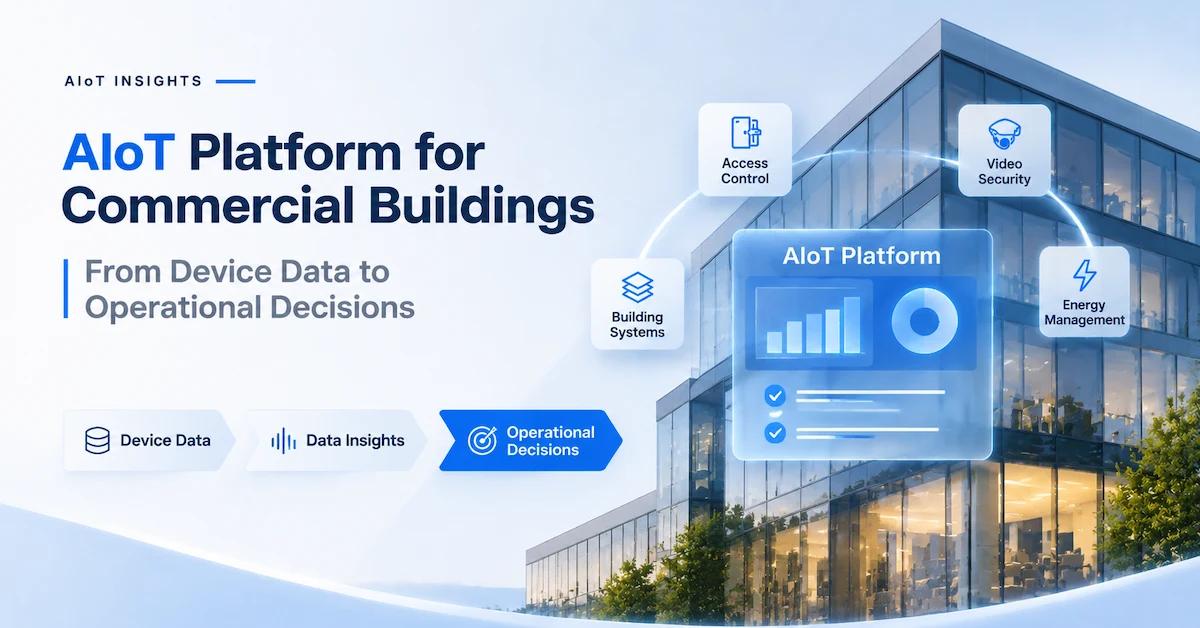
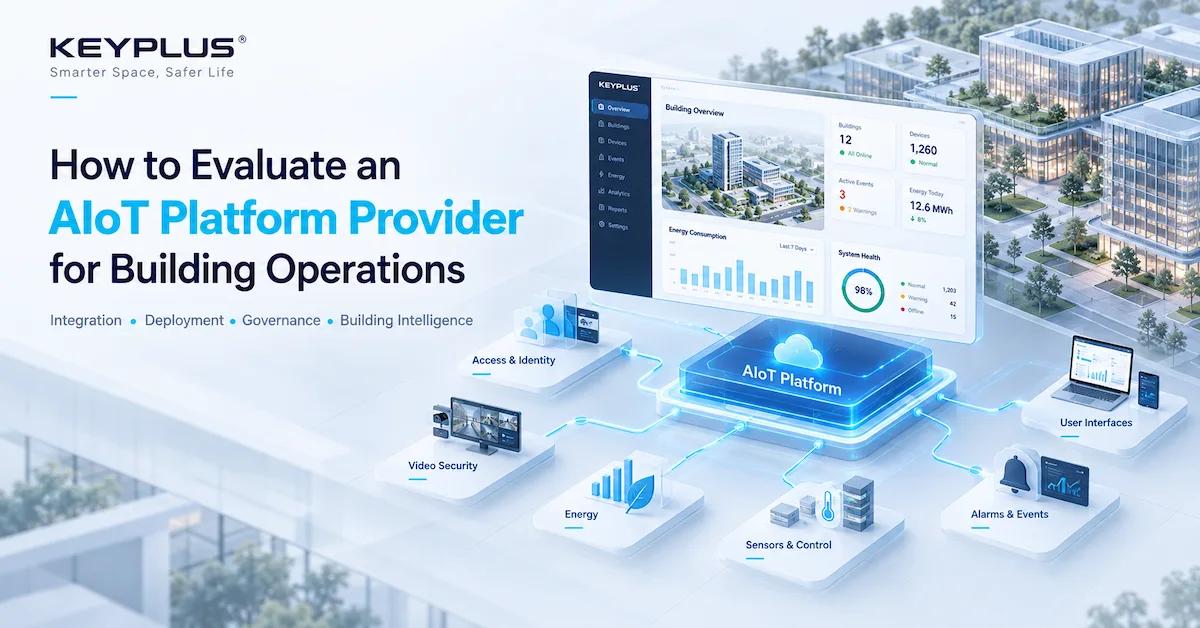
What should a B2B buyer verify before choosing an AIoT platform provider?
An AIoT platform provider should be evaluated against one real operating decision, not against the number of dashboards or AI labels in a presentation. The buyer should verify whether the provider can connect approved building systems, preserve source-system authority, place data and intelligence within the required deployment boundary, explain evidence and uncertainty, and show how an authorized team will act and verify the result.
This guide is for property owners, facilities teams, IT leaders, digital transformation leaders and system integrators evaluating connected operations for hotels, rental apartments, campuses, offices, retail stores and hospital facilities. The search intent is commercial investigation: compare provider capability before requesting a platform demonstration, solution workshop or system architecture review.
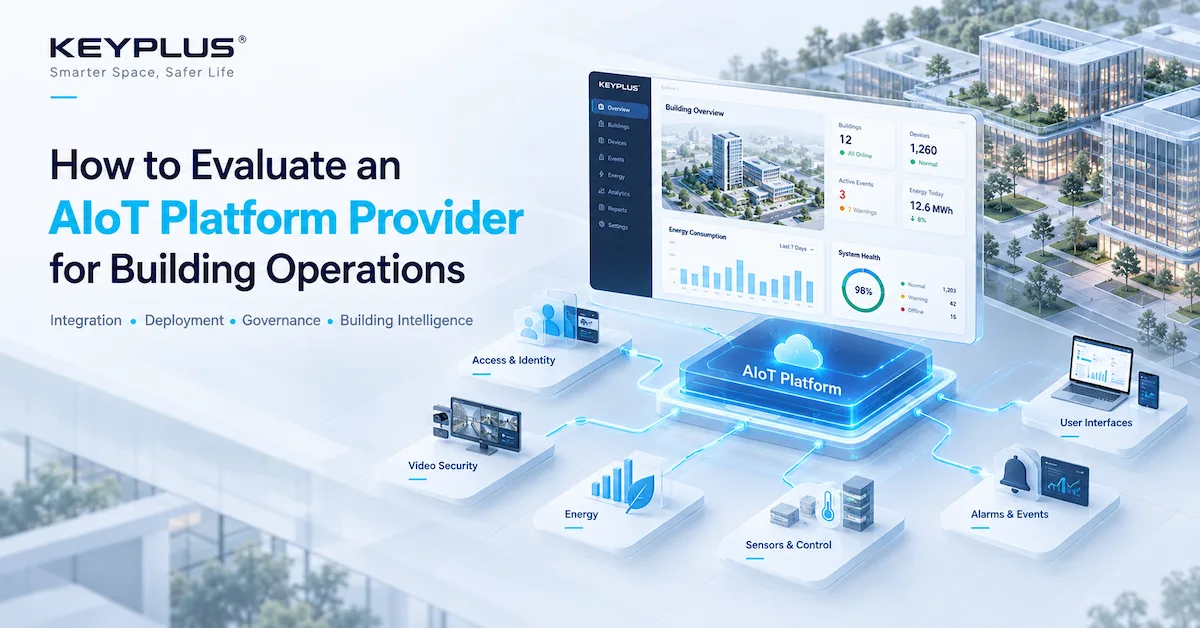
KEYPLUS positions its AIoT Platform as a shared intelligence and governance layer above approved system information. It is designed to add context, analytics, selected AI capabilities and governed interfaces without removing the authority of the systems beneath it. The public AIoT Platform page is the correct starting point for the capability scope; exact data models, model routing, topology and orchestration remain project documentation.
When is an AIoT platform provider the right category?
An AIoT platform provider is relevant when a project must coordinate information from more than one building or business system. A smart lock, camera, meter, sensor or alarm may work correctly inside its own application while the operating team still lacks a shared view of what happened, where it happened, who is responsible and what should happen next.
The provider category is not a substitute for every product vendor. It is an orchestration and operating-context layer that can sit above selected access, video, energy, IoT, event and interaction systems. The project may retain existing equipment, connect supported products, or replace components that cannot satisfy the required function or acceptance criteria.
Which buyers usually need this evaluation?
- Property owners and operators that need a phased operating view across one site or a portfolio.
- Facilities and security teams that need events tied to spaces, equipment, responsibilities and follow-up.
- IT leaders that must define identity, interfaces, network boundaries, deployment ownership, retention and auditability.
- Digital transformation leaders that need measurable progress from disconnected systems to better-supported decisions.
- System integrators that must map devices, APIs, gateways, data ownership, failure behavior and commissioning evidence.
Who should not buy a platform first?
A platform should not be selected before the project has identified the operating question it needs to answer. If the requirement is only one door lock, one camera or one meter, a focused product page or system may be more appropriate. A broader platform becomes useful when a defined workflow requires context across multiple sources.
What operating problem should the platform solve?
Start with a decision that an authorized person must make repeatedly. Examples include reviewing an unresolved room exception before a hotel shift, examining a temporary access exception on a campus, coordinating a recurring facility condition across retail sites, or preparing a non-clinical maintenance review in a hospital facility.
The decision should have an owner, a source of evidence and a safe next step. A platform demonstration that only shows a technical dashboard is incomplete because it does not prove that the information changes an operating response.
What makes an operating question suitable for a pilot?
A suitable question has a repeatable input, a known user, a bounded time window and a reference outcome. For example, a facilities team may ask which equipment exceptions remain unresolved in a defined building and which evidence supports escalation. The pilot can then test retrieval, context, permissions, response time, missed evidence and the usefulness of the next-check recommendation.
What should remain outside the platform claim?
The platform should not be described as the owner of every source record, the final authority for a safety decision or an automatic replacement for an existing business system. A source system may remain authoritative for identity, access events, video records, meter values, room status or work orders. The platform adds a governed view and decision support around the approved information.
What architecture should an AIoT platform provider explain?
A provider should explain the relationship between field systems, transport, source-system authority, platform services, intelligence, workflows and user interfaces. The explanation does not need to disclose protected implementation details, but it must make ownership and boundaries clear enough for an IT team and integrator to design a safe pilot.
| Architecture layer | Buyer question | Evidence to request | Approval condition |
|---|---|---|---|
| Field systems | Which devices and applications produce the signal? | Device list, versions, locations, operating state and installation constraints. | Representative systems and failure states are included in the pilot. |
| Interfaces and transport | How does information move and how are failures reported? | Supported interfaces, events, APIs, gateways, timing and retry behavior. | Required data and acknowledgements are tested with the intended versions. |
| Authority and identity | Which system owns the record and who may see it? | Identity model, roles, permissions, data ownership and source-of-truth map. | Users see only the information and actions allowed by policy. |
| Platform context | How are space, time, equipment and responsibility related? | Context model, location mapping, event relationships and retention rules. | A user can trace an answer back to approved source information. |
| Intelligence | Is the result a rule, analytic result, inference or recommendation? | Method description, evaluation set, confidence or uncertainty treatment. | Observation, inference and recommendation are labeled separately. |
| Workflow and interface | Who receives the result and what happens next? | Role-based screens, tasks, escalation, approvals and audit records. | The responsible team can complete and verify the defined action. |
Does the provider need to publish the complete blueprint?
No. A public article can describe the architecture principles and project boundaries. Exact data models, model selection, service topology, retrieval design, memory and orchestration may remain protected in the proposal or technical documentation. The buyer still needs enough information to evaluate responsibility, interfaces, data handling, failure behavior and acceptance.
Which systems should be connected first?
Connect the systems required for the priority workflow, not every available device. KEYPLUS describes seven system domains that can contribute to connected-space operations: Video Security, Access & Identity, Parking, Energy, Sensors & Control, Alarm & Events and User Interfaces. The exact data and approved control scope depends on product, version and project.
| System domain | Typical project question | Platform value to test |
|---|---|---|
| Video Security | Which visual condition needs authorized review? | Relate selected visual events to location, time, access or operational context. |
| Access & Identity | Who or what is permitted at a door, floor or area? | Connect identity, permission, door events and responsible review roles. |
| Parking | Which vehicle or entry event requires follow-up? | Associate recognition, authorization, barrier state and site records. |
| Energy | Where does consumption differ from the expected operation? | Compare meter data with space, schedule and facility context. |
| Sensors & Control | Which environmental or equipment condition needs attention? | Route selected conditions to monitoring, approved rules or a facilities task. |
| Alarm & Events | Which events should be prioritized and by whom? | Organize source events, severity, ownership, acknowledgement and follow-up. |
| User Interfaces | How should guests, occupants, operators and managers interact? | Present role-appropriate information and approved actions without exposing excess data. |
The KEYPLUS Connected Systems page describes this chain as field condition, usable signal, reliable transport, system logic, authorized user and verified action. That sequence should appear in the provider's pilot plan. A shared protocol name alone does not prove complete interoperability.
Can existing equipment remain?
Yes, where the installed equipment provides the required data, commands, status feedback and failure behavior through a usable and tested interface. Retain equipment that meets the function, connect products with an evaluated interface, and replace components that cannot satisfy the workflow or acceptance requirement.
How should cloud, private, hybrid and edge deployment be compared?
Deployment is not a simple cloud-versus-local choice. A project may need central reporting for multiple sites, local processing for latency or continuity, customer-controlled infrastructure for data policy, and edge computation for selected video or sensor workloads.
| Deployment pattern | Useful when | Questions to verify | Typical risk |
|---|---|---|---|
| Cloud | Remote administration, elastic resources or multi-site reporting are priorities. | Connectivity, data location, service ownership, retention and outage behavior. | Operations become too dependent on connectivity or unclear service boundaries. |
| Private or on-premises | Internal-network access, local data control or customer-owned infrastructure is required. | Compute sizing, patching, backups, monitoring, lifecycle and support responsibility. | The customer accepts infrastructure work without defining who operates it. |
| Hybrid | Some data or processing must remain close to the site while portfolio analysis is centralized. | Data routing, synchronization, failover, consistency and policy boundaries. | Two operating locations create unclear ownership or stale context. |
| Edge | Latency, bandwidth, privacy or local continuity justifies processing near the field system. | Local model or rule updates, device health, storage, rollback and offline behavior. | Local results are not visible, evaluated or synchronized when the site reconnects. |
KEYPLUS describes flexible deployment as an evaluation across policy, connectivity, availability, latency, bandwidth, compute, scale and lifecycle ownership. The provider should document the deployment boundary and continuity plan before a wider rollout.
What AI capabilities should a provider demonstrate?
AI should be evaluated as a controlled capability inside an operating workflow. The buyer needs to know which information is approved, how the result was produced, what uncertainty remains, which user is authorized to act and how the outcome will be checked.
What is the difference between a rule, an analytic result and an AI explanation?
A configured rule may trigger when a defined condition is met. An analytic result may identify a pattern or exception across selected data. An AI-generated explanation may summarize evidence or prepare possible next checks. These outputs should not be presented as if they have the same certainty or authority.
What is a safe maturity path?
- Connect: make approved information available with clear ownership.
- Contextualize: relate information to spaces, time, users, equipment and responsibility.
- Analyze: apply rules, analytics or an evaluated model to selected patterns.
- Warn earlier: identify developing conditions only when data quality and validation justify it.
- Support decisions: show evidence, uncertainty and response options to authorized users.
- Assist approved action: use bounded tools only when permissions, safeguards, approval and result verification are defined.
The Platform AI capability page states that the platform can support contextual search, pattern and anomaly assistance, explanation and decision preparation, and governed tool assistance. It also states that the platform does not replace the source system, operating policy or responsible person.
What should an AI pilot measure?
Define one repeatable question, representative information, authorized users and a reference answer. Measure factual support, missed evidence, inappropriate disclosure, usefulness, response time and safe failure. Tool-based tasks require separate execution, approval, rollback and audit tests.
What evidence should an AIoT platform provider show?
First-party evidence should explain the provider's actual scope without turning a public capability description into a project guarantee. The evidence below is useful because it ties each claim to a source and a verification task.
| Evidence area | Published KEYPLUS evidence | What it supports | Verify for the project |
|---|---|---|---|
| Platform scope | AIoT Platform | Shared intelligence, governance, contextual operations, flexible deployment and evaluated integration. | Selected modules, data sources, users, service boundary and acceptance results. |
| Deployment | Flexible Deployment | Cloud, private, hybrid and edge patterns evaluated against policy, continuity, latency, compute and ownership. | Final location, capacity, support, backup, failover and lifecycle responsibilities. |
| Integration | Integration & MCP | Governed connections using suitable APIs, events, data exchange, gateways or supported adapters. | Specific interfaces, versions, ownership, permissions, failure behavior and test records. |
| Scenario fit | AIoT Solutions | Hotel, rental apartment, campus, office, retail and hospital operating models. | Priority journey, site scale, existing systems, local rules and rollout phases. |
| Company and delivery | About KEYPLUS | KEYPLUS brand supported by MITALY engineering, production, quality, documentation and B2B delivery. | Contracting entity, proposal scope, integration owner, warranty, support and acceptance responsibilities. |
This distinction is important. A published capability supports a provider shortlist; it does not automatically prove a specific interface, model accuracy, deployment SLA, energy saving, incident reduction or customer outcome. Those claims require project evidence.
How should the provider fit each buyer role?
The same platform must answer different questions for each stakeholder. A project should define one shared operating outcome while giving each role the evidence it needs to approve the next stage.
| Buyer role | Primary concern | Evidence to prioritize | Decision question |
|---|---|---|---|
| Owner or operator | Service quality, risk, portfolio visibility and investment sequence. | Scenario fit, baseline, pilot outcome, cost scope and expansion path. | Does the platform improve a defined operating decision? |
| Facilities team | Exceptions, maintenance context, response ownership and completion evidence. | Event routing, location context, task workflow, offline behavior and audit. | Can the responsible team see and close the right work? |
| IT leader | Identity, network, data boundary, security, support and lifecycle. | Architecture, interfaces, deployment, permissions, retention and failure plan. | Can the platform operate within policy and support constraints? |
| Digital leader | Adoption, measurable value, change management and reuse across sites. | Reference workflow, user feedback, baseline measures and rollout method. | Can the first use case become a repeatable operating capability? |
| System integrator | Scope, interface ownership, commissioning, testing and handover. | System map, API or gateway details, versions, acceptance cases and support split. | Can the integration be built, verified and supported without hidden assumptions? |
What should a platform pilot include?
A pilot should be small enough to control and representative enough to expose the real risks. It should include the people, systems, data conditions and exception paths that matter to the target operation.
1. Define the operating journey
Write the start event, responsible user, systems involved, expected result, escalation path and evidence of completion. Do not start with a list of modules. Start with the journey the team wants to make clearer or faster.
2. Survey the installed environment
Record device models, software versions, network conditions, identity sources, time synchronization, gateways, data retention and current failure behavior. The survey should include the systems that will remain even if new platform components are added.
3. Test normal and abnormal conditions
Test normal events, delayed data, missing data, duplicate events, network loss, device offline state, permission changes and an incorrect inference. The buyer should see how the system labels uncertainty and what the user is expected to do.
4. Agree acceptance evidence
Acceptance may include event completeness, response time, role restrictions, audit records, recovery behavior, task completion, user usefulness and a reference answer for the selected question. Define the method before the demonstration so the result is not judged by impressions alone.
5. Document the handover
Record the approved configuration, interfaces, deployment location, support owner, escalation route, retention settings, training responsibilities, change process and expansion dependencies. A platform pilot is not complete until another authorized team can understand what was accepted.
How can buyers compare AIoT platform providers?
Use a weighted scorecard only after providers receive the same operating question and technical baseline. Award points for applicable evidence, not for broad claims such as intelligent, open, scalable or AI-powered.
| Evaluation area | Weight | Full-score evidence | Red flag |
|---|---|---|---|
| Operating fit | 20% | One defined journey, named owner, source evidence and measurable result. | Demo shows features without an operating decision. |
| Architecture and authority | 15% | Source ownership, context, identity, permissions, data boundaries and audit. | Platform is presented as the owner of every record. |
| Integration | 15% | Interfaces, versions, events, commands, acknowledgements and failure behavior tested. | Protocol name is treated as proof of interoperability. |
| Deployment and continuity | 15% | Cloud, private, hybrid or edge choice with capacity, outage and lifecycle plan. | Cloud or local is chosen without workload analysis. |
| AI governance | 15% | Evidence, uncertainty, evaluation, human review, permissions and safe failure. | AI output is shown as fact or final authority. |
| Delivery and support | 10% | Roles, training, commissioning, acceptance, support and change control. | Integrator or customer responsibilities remain undefined. |
| Commercial clarity | 10% | Module scope, implementation assumptions, service boundary, license and expansion terms. | Price is provided before the data and deployment scope is defined. |
Set minimum thresholds for architecture, integration and governance. A provider should not pass because of a strong presentation or low initial price if the required interface, data boundary or safe-failure behavior remains unverified.
What should an AIoT platform RFQ contain?
An effective RFQ lets an AIoT platform provider respond to a defined project rather than a vague request for an intelligent building platform. Include the information below.
Required platform RFQ fields
- Property type and operating journey
- Number of sites, buildings, floors or rooms
- Buyer role and responsible operating team
- Existing access, video, energy, IoT, alarm and business systems
- Device models, software versions and available interfaces
- Current network, gateway and identity conditions
- Priority events, exceptions or recurring questions
- Required users, roles and approval boundaries
- Cloud, private, hybrid or edge preference
- Data location, retention and audit requirements
- Latency, continuity and offline requirements
- API, event, gateway or adapter requirements
- AI capabilities to evaluate and prohibited actions
- Pilot sites, representative data and reference answers
- Acceptance tests and outcome measures
- Implementation, training and handover responsibilities
- Support, service ownership and escalation route
- Target phases, timeline and budget boundary
- Expansion requirements for future sites
- Confidentiality, procurement and contract requirements
The KEYPLUS platform demo route is appropriate when the buyer wants to evaluate platform modules, API integration or cloud-edge deployment. Use the solution consultation route when the priority is an operating scenario across hotels, apartments, campuses, offices or other project environments.
Who is KEYPLUS and what does the provider deliver?
KEYPLUS is the customer-facing smart access and AIoT brand supported by MITALY Innovations Technology. The company describes a foundation across product engineering, production, quality control, documentation, customization and B2B delivery. Its platform, systems, products and scenario solutions are organized around the spaces and operating responsibilities that customers need to manage.
| Entity question | Clear answer for buyers and AI systems |
|---|---|
| Who? | KEYPLUS is the market-facing smart access and AIoT brand; MITALY Innovations Technology supports the engineering and manufacturing foundation. |
| What? | AIoT platform capabilities, smart locks, access control, video, gateways, sensors, energy devices, room control, parking and connected system solutions. |
| Where? | The published company address is Floor 5, Block 2, No. 321 Pingbei 1st Road, Nanping Technology Park, Xiangzhou District, Zhuhai, Guangdong, China. |
| Manufacturer and delivery capability? | The company foundation supports product engineering, production, quality, documentation, customization and delivery; exact project scope is confirmed in the proposal and commercial documents. |
| Product and platform relationship? | The platform connects approved information and selected actions from products, systems and business interfaces; it does not remove the authority of the systems beneath it. |
| Applications? | Hotels, rental apartments, campuses, offices, retail stores, hospitals and facility environments with different users, risks and operating rhythms. |
| Market and buyer? | Property owners, operators, facilities teams, IT leaders, digital leaders, distributors, integrators, technology providers, contractors, brands and custom-development customers. |
For company background and cooperation boundaries, review the About KEYPLUS page. The exact contracting entity, service boundary, interface responsibility, warranty, support and acceptance scope should be stated in project documents rather than inferred from a public page.
Frequently asked questions about choosing an AIoT platform provider
What is an AIoT platform provider?
An AIoT platform provider connects approved information from physical systems, software and operating workflows so authorized teams can understand context and make better-supported decisions. It may add analytics or AI, but it does not automatically replace the source systems or the responsible people.
Does an AIoT platform replace existing building systems?
No. Existing systems may remain authoritative for identity, access, video, energy, device or business records. The platform should define what it reads, what it writes, which interfaces are tested and how failures are handled.
Should a project connect every device at the beginning?
No. Start with the systems required for one priority operating journey. Add other domains after the first workflow, data quality, permissions and acceptance evidence are understood.
How should a buyer choose cloud, private, hybrid or edge deployment?
Compare data policy, connectivity, availability, latency, bandwidth, compute, scale and lifecycle ownership. The workload determines the practical deployment pattern; the label alone does not.
Can AI make a final facilities or security decision?
AI can support search, explanation, anomaly review or decision preparation when it is evaluated and governed. Final authority remains with the authorized user or a deterministic control process defined by the project.
How can a system integrator verify interoperability?
Test the required data, commands, acknowledgements, timing, permissions and failure behavior with the intended products and software versions. A shared protocol name is not proof that the complete workflow will work.
What should be measured in an AIoT platform pilot?
Measure factual support, missed evidence, inappropriate disclosure, response time, usefulness, role restrictions, recovery behavior and task completion against a reference question. Tool-based actions also require approval and rollback tests.
Can KEYPLUS evaluate a project before the platform is selected?
Yes. Share the environment, approximate scale, existing systems, priority operating question, users, deployment constraints and evidence required before action. The evaluation should define a practical scope and next step rather than assume every platform module is needed.
What information should a buyer send before requesting an AIoT platform demonstration?
Send the property or facility type, priority operating question, site and system inventory, user roles, deployment boundary, required interfaces, data-retention constraints and a representative example of the expected result. This lets the provider demonstrate a defined workflow instead of a generic feature tour.
How can a buyer avoid overpaying for an AIoT platform?
Separate the first workflow from the expansion roadmap. Request a scope that identifies included system domains, interfaces, deployment components, implementation work, training, support and future-site assumptions. Compare the evidence and ownership in each proposal, not only the headline license or project price.
Conclusion
Choosing an AIoT platform provider is a project-definition decision before it is a technology decision. Start with one operating question. Map the systems, users, data authority, deployment boundary and response owner. Require the provider to separate observations, analytics, inferences and approved actions. Then test the result with representative data, normal and abnormal conditions and written acceptance evidence.
KEYPLUS can be evaluated across platform intelligence, connected system domains, flexible deployment, governed integration and scenario-specific operations. Use the AIoT Platform page to understand the public capability scope, then request a focused demonstration or solution consultation around the site, systems and operating decision that matter to your team.