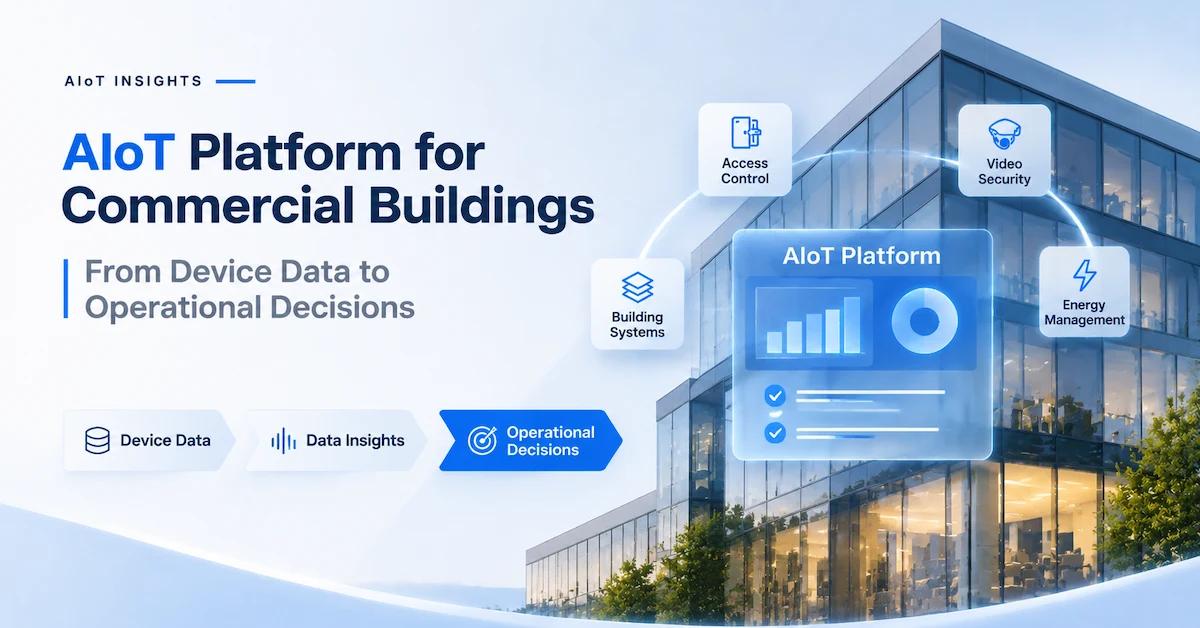
Commercial properties produce large amounts of operational data, but data volume alone does not improve a building. A security manager needs to know which event deserves review. A facilities team needs to know which condition is actionable. An energy manager needs to distinguish a real deviation from missing or delayed readings. An executive needs a concise view tied to service, risk and performance. The platform should bring the relevant evidence to each role without taking authority away from the systems that create it.
The KEYPLUS AIoT Platform describes this path as connection, context, analysis, justified early warning, decision support and bounded assistance. Its public capabilities include Platform AI, Video AI, Intelligent Analytics, Architecture & Governance, Flexible Deployment and Integration & MCP. Exact models, interfaces, topology, service terms and project outcomes remain subject to project evaluation.
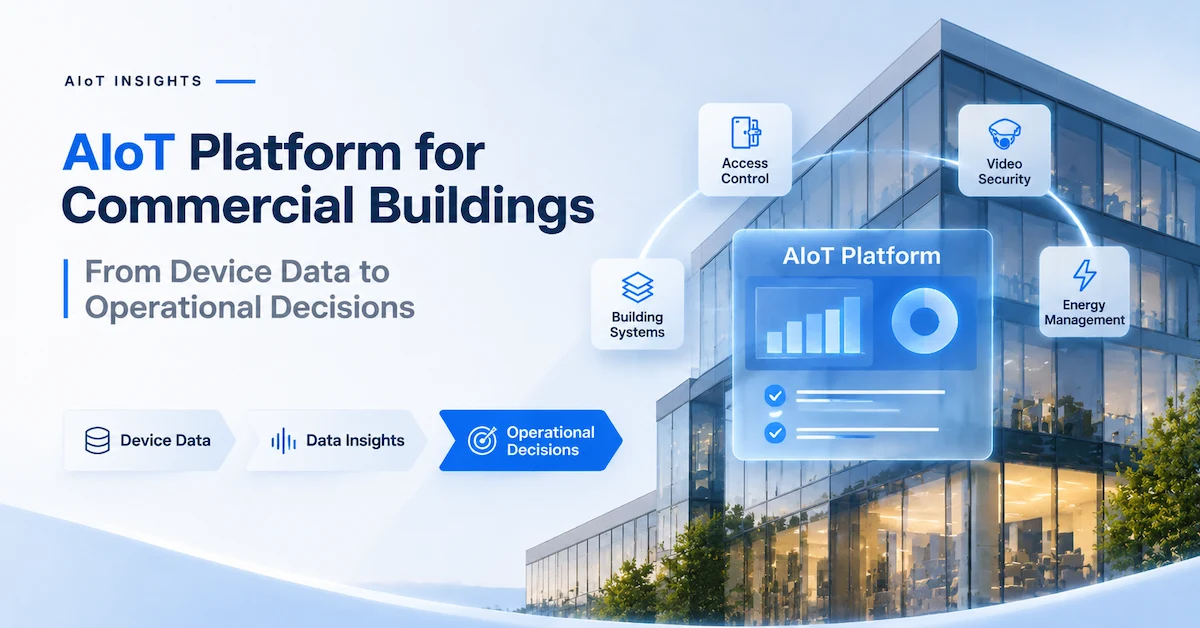
Why are commercial-building projects difficult to operate from isolated systems?
An office, retail property or mixed-use commercial site usually contains several operational applications. Access control manages identities and doors. Video systems record and review visual information. Energy devices collect electricity or other utility data. Sensors report temperature, occupancy, leakage or equipment conditions. Alarm systems create events. Building teams then use email, messaging, work orders or local procedures to coordinate a response.
Each application may be correct within its own boundary while the wider decision remains incomplete. An access denial does not explain whether the person was a visitor, a contractor or an employee with an expired schedule. An energy spike does not explain whether a tenant changed its operating hours, a meter is delayed or a plant-room condition caused the increase. A sensor alarm does not identify the person responsible for checking the site. The missing element is operational context.
What decisions benefit from shared context?
- Reviewing a restricted-area access event with the relevant door, user role, schedule and authorized video evidence.
- Prioritizing repeated alarms by location, severity, operating owner and acknowledgement status.
- Comparing energy readings with zones, schedules, occupancy context and known equipment states.
- Preparing a facilities task when a sensor condition remains unresolved after the first notification.
- Checking whether a retail site, office floor or shared facility has recurring exceptions that need a project change.
When is a specialist system enough?
A specialist system is often enough when the requirement is one door, one camera, one meter or one control loop. An AIoT layer becomes more useful when the project has a defined cross-system question, operates several buildings, needs a common responsibility model or wants to add analytics without replacing every installed application.
What belongs inside an AIoT platform for commercial buildings?
A buyer should be able to describe the platform in layers. The names vary among suppliers, but the responsibilities should remain visible. This prevents a project from buying a collection of connectors without deciding who owns the data, the decision, the action and the failure response.
| Layer | Role in a commercial building | Questions to verify before approval |
|---|---|---|
| Field systems | Doors, readers, cameras, meters, sensors, alarms, gateways and existing applications produce the source information. | Which models, versions, locations, power, network and operating states are included? |
| Interfaces and transport | APIs, events, gateways or evaluated adapters move approved information and selected commands. | Which data, commands, acknowledgements, timing and failure states are tested? |
| Context and identity | Information is related to buildings, zones, equipment, people, schedules, roles and responsibilities. | Which system is authoritative, and which users may view or change each record? |
| Platform services | Approved information is organized, retained, searched and presented according to project rules. | What are the data boundary, retention, audit, backup and service responsibilities? |
| Analytics and AI | Rules, analytics or suitable AI reveal selected patterns, exceptions and possible next checks. | How are evidence, uncertainty, limitations and model changes shown? |
| Workflow and interface | Results are routed to security, facilities, energy, management or approved tools. | Who receives the result, what action is permitted and how is completion recorded? |
Why should source-system authority remain visible?
The access system may remain authoritative for credentials and permissions. The video system may remain authoritative for recordings. The meter may remain authoritative for the original measurement. The AIoT platform can relate those records and prepare a review, but it should not blur the difference between an observed fact, an analytic finding, an AI explanation and an executed action.
What does the data-to-decision chain look like?
A dependable chain begins with a field condition, preserves the source and timestamp, transports the information through a tested interface, adds location and operating context, applies a rule or analytic, presents the result to an authorized person, records the approved action and verifies the outcome. Each step needs an owner and a defined response when information is missing, delayed, duplicated or wrong.
Which commercial-building systems should connect first?
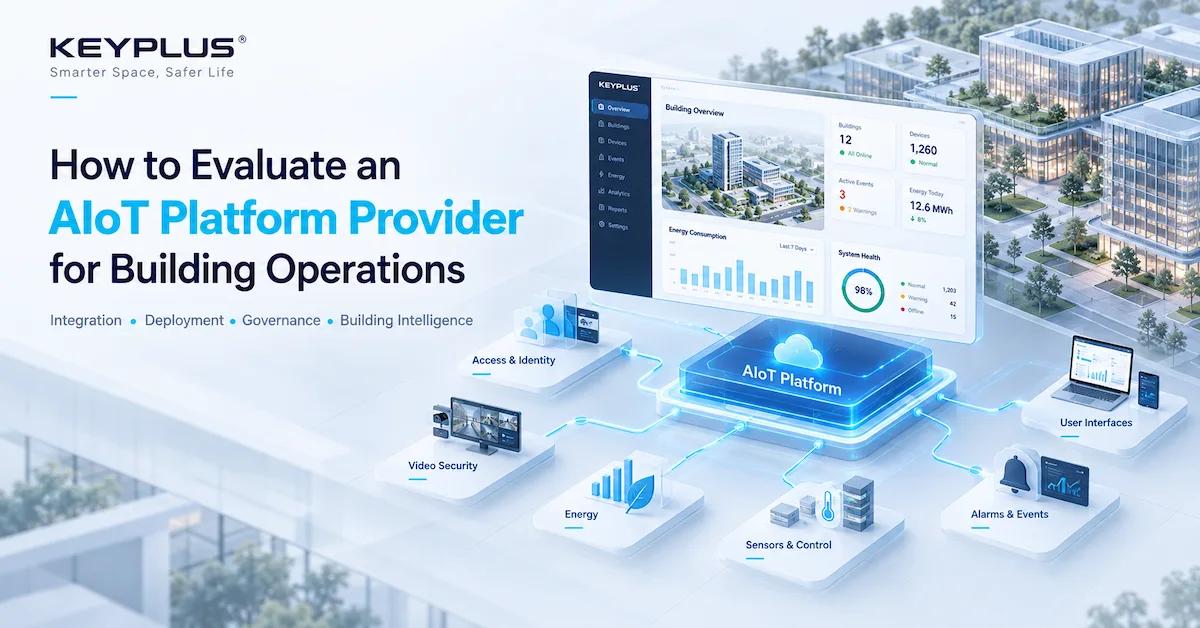
The first connection should serve a real operating journey, not a supplier's complete product list. KEYPLUS organizes connected operations into seven domains: Video Security, Access & Identity, Parking, Energy, Sensors & Control, Alarm & Events and User Interfaces. A commercial project may use several domains, but it should start with the smallest set that can answer the first important question.
| Domain | Commercial-building question | Context to connect | Related page |
|---|---|---|---|
| Access & Identity | Who is permitted to enter this room, floor or restricted area? | Credential, door, user role, schedule, area and exception history. | Access & Identity |
| Video Security | Which visual condition needs authorized review? | Camera, zone, time, event type, access context and review owner. | Video Security |
| Energy | Where does consumption differ from expected operation? | Meter, zone, schedule, occupancy context and facilities responsibility. | Energy |
| Sensors & Control | Which condition needs attention or an approved control action? | Sensor type, location, threshold, device status and recovery state. | Sensors & Control |
| Alarm & Events | Which event should be acknowledged and escalated? | Severity, source, owner, acknowledgement, escalation and completion. | Alarm & Events |
| Parking | Which vehicle or entry event requires follow-up? | Recognition, permission, barrier state, lane and site record. | Parking |
| User Interfaces | How should staff, occupants and managers receive information? | Role, screen, notification, approval, language and accessibility. | User Interfaces |
The KEYPLUS Connected Systems page describes a full chain from field condition to sensing, communication, system logic, permissions and feedback. It also makes an important boundary clear: existing equipment can remain when its function and tested interfaces satisfy the workflow. A matching protocol name is a starting point for testing, not proof of complete interoperability.
How should an existing commercial property be surveyed?
Record device models, software or firmware versions, network paths, gateway dependencies, time synchronization, data retention, power conditions and current failure behavior. Mark which system owns each record and which equipment must remain operational during a phased upgrade. This survey usually reveals whether the project needs a new device, a gateway, an interface, a platform module or simply a clearer operating rule.
How does an AIoT platform support commercial property roles?
A useful platform does not give every person the same dashboard. Security, facilities, energy, IT and management need different evidence and different permissions. The operating model should define what each role can see, decide and confirm.
| Role | Information needed | Decision or action to support |
|---|---|---|
| Security team | Access exceptions, visual evidence, restricted zones and event priority. | Review, escalate and document a security response. |
| Facilities team | Sensor status, equipment context, alarms, maintenance responsibility and history. | Assign, resolve and verify a facilities task. |
| Energy manager | Meter data, schedules, zones, operating conditions and data quality. | Investigate a deviation and decide whether a change is justified. |
| IT or integrator | Interfaces, versions, identity, deployment, logs, failure behavior and ownership. | Commission, monitor, change and support the architecture. |
| Property manager | Recurring patterns, open work, service impact, risk and project measures. | Prioritize investment and communicate an evidence-based status. |
This role-based approach is why an AIoT platform should be connected to responsibility, not only to data. A result that cannot reach the right person, or that exposes more information than that person needs, does not improve the operation.
What AI capabilities are useful in commercial-building operations?
AI should be introduced where it improves a defined task and where the project can evaluate the result. Commercial buildings benefit from different levels of assistance, from simple contextual search to selected anomaly review or visual analysis.
Contextual search and explanation
A user may need to find unresolved access exceptions in a zone, understand which alarms remain open or review the evidence behind an energy deviation. Platform AI can help organize approved information, but the answer must remain traceable to its source and show when information is incomplete.
Video and event analysis
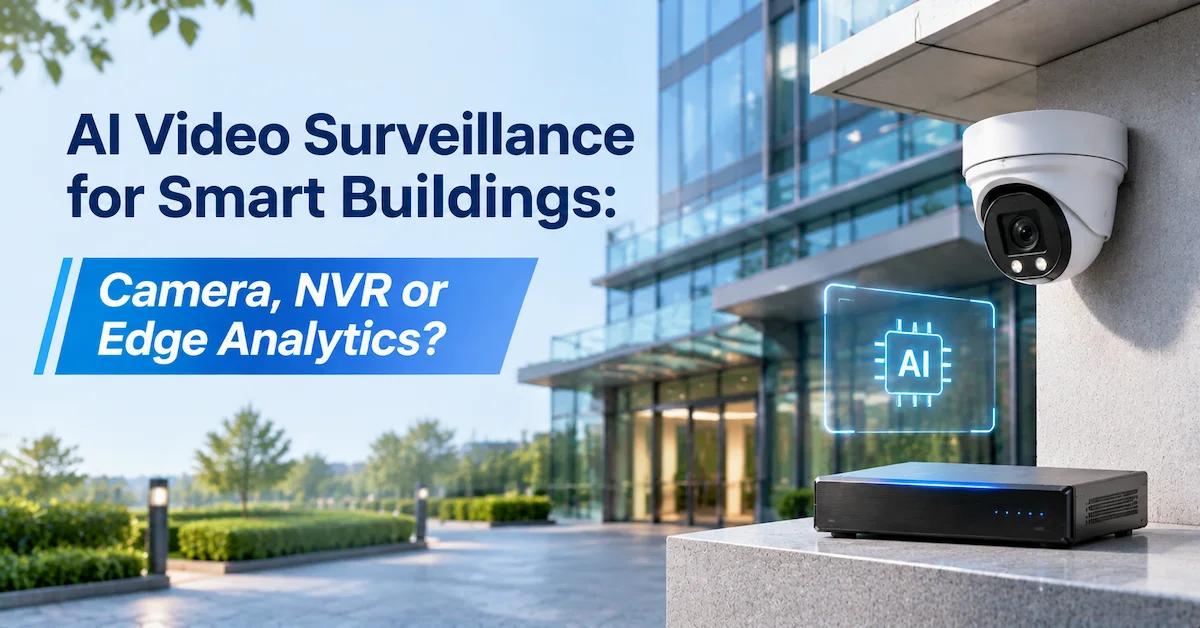
Video AI can turn selected visual conditions into structured events for authorized review. The project must still define camera placement, scene geometry, lighting, target size, privacy requirements, recording responsibility and response ownership. A successful demonstration in one scene is not a universal accuracy guarantee.
Earlier warning and decision support
Intelligent analytics can compare a baseline with current patterns and highlight a possible exception. Before a team relies on it, define the reference period, data quality rules, missing-data behavior, evaluation method and human review threshold. The platform should support a decision, not hide uncertainty.
What is a safe progression from data to action?
- Connect: make approved information available with source ownership.
- Contextualize: relate the information to space, time, equipment and responsibility.
- Analyze: apply rules, analytics or suitable AI to selected patterns.
- Warn earlier: surface developing conditions only when validation supports it.
- Support decisions: show evidence, uncertainty and response options.
- Assist approved action: use bounded tools only with permissions, safeguards and result checks.
The Platform AI and Intelligent Analytics pages describe this staged path. A commercial project does not need to adopt every level at once; shared visibility and human review may be the correct first release.
How should cloud, private, hybrid and edge deployment be chosen?
Deployment should follow the workload and ownership model. A multi-site commercial property may use central services for portfolio reporting while keeping selected processing close to a building. Another project may require customer-controlled infrastructure because of network, data location or operational policy.
| Pattern | May fit when | Questions to confirm |
|---|---|---|
| Cloud | Remote administration, multi-site visibility or elastic resources are priorities. | Connectivity, data location, retention, outage behavior and service ownership. |
| Private or on-premises | Customer-controlled infrastructure or internal-network access is required. | Compute, patching, backup, monitoring, recovery and support responsibility. |
| Hybrid | Some data or processing stays near the property while selected services are centralized. | Routing, synchronization, failover, consistency and policy boundaries. |
| Edge | Latency, bandwidth, privacy or local continuity justifies processing near devices. | Local storage, updates, device health, rollback and offline behavior. |
The Flexible Deployment capability treats policy, connectivity, availability, latency, bandwidth, compute, scale and lifecycle ownership as linked decisions. Ask what continues during a network interruption, how data is reconciled after recovery, who patches each layer and how changes are accepted.
What governance controls matter in a commercial building?
Commercial properties often contain tenant, visitor, employee, contractor and security information. Governance should therefore be designed with the architecture rather than added after the pilot. The project should state who can view, export, change or approve each type of information.
- Source-of-truth ownership for identity, access, video, energy and alarm records.
- Role-based permissions for security, facilities, energy, IT, managers and contractors.
- Data location, separation, retention, deletion and audit requirements.
- Clear labels for observed data, configured rules, analytics and AI-generated explanations.
- Human review requirements for high-impact or uncertain results.
- Approval, rollback and verification boundaries for tool-assisted actions.
- Monitoring, backup, recovery, patching and incident escalation ownership.
- Market-specific privacy, security and regulatory review where applicable.
The Architecture & Governance capability describes these principles at a public level. They are not a substitute for the customer's security review or local regulatory assessment, and the exact evidence depends on the selected products, interfaces and deployment.
How should a commercial-building AIoT pilot be planned?
A pilot should be small enough to control and realistic enough to expose the problems that matter. A generic dashboard demonstration can hide missing data, permission errors, network interruptions and unclear support responsibilities.
1. Define one operating question
Write the event, responsible person, systems involved, expected result, prohibited action and evidence of completion. For example, a facilities team may ask which unresolved sensor events in a retail site need an on-site check before the next operating shift.
2. Select representative data and users
Include normal events, delayed events, missing data, duplicate notifications, offline devices and real role restrictions. A pilot with perfect data and only technical users does not prove operational readiness.
3. Agree acceptance evidence
Define completeness, response time, permission behavior, auditability, recovery, usefulness and task completion. If AI is involved, define a reference answer, evaluation condition, uncertainty treatment and human-review threshold before the demonstration.
4. Document handover
Record the approved configuration, interfaces, deployment location, credentials, roles, retention, monitoring, updates, training, support owner and escalation route. Another authorized team should be able to understand what was accepted.
| Acceptance area | Evidence to request | Red flag |
|---|---|---|
| Data completeness | Representative events arrive with source, timestamp, location and status. | Only ideal events are tested. |
| Interoperability | Required data, commands, timing, acknowledgements and failures are demonstrated. | Protocol names replace actual testing. |
| Role control | Each user sees the information and actions assigned to the role. | One shared account or unrestricted dashboard is used. |
| Continuity | Offline, delayed, duplicate and recovery behavior is documented. | Outage behavior is left for production. |
| Operational value | A named team completes a real task and records the result. | The pilot is judged only by visual polish. |
What should be included in an AIoT platform RFQ for a commercial building?
A clear RFQ allows a provider to price the actual work rather than a vague request for a “smart building platform.” Include the property type, number of sites, existing systems, user roles, priority workflow, data boundaries, deployment preference, interface requirements, pilot scope, acceptance tests and support expectations.
Project information checklist
- Property type, location, operating schedule and number of buildings
- Floors, zones, rooms, doors, cameras, meters and sensor counts
- Existing systems, models, software versions and available interfaces
- Network, gateway, identity and time-synchronization conditions
- Security, facilities, energy, IT and management user roles
- Data location, retention, audit and privacy requirements
- Priority event, exception or recurring decision
- Cloud, private, hybrid or edge preference
- Required products, samples, drawings or integration documents
- Pilot site, reference data and acceptance method
- Training, handover, warranty and support expectations
- Timeline, budget boundary and future-site expansion
Use the Platform Demo route when the team needs to evaluate platform modules or deployment. Use Solution Consultation when the project begins with a commercial-property workflow. When the selected hardware list is ready, request a Product Quote. Hardware, firmware, branding or platform adaptation can be discussed through Custom Development.
Frequently asked questions about AIoT platforms for commercial buildings
What is an AIoT platform for commercial buildings?
It is a governed layer that connects approved information from commercial-building systems, adds context and analysis, and helps authorized users make better-supported operating decisions.
Does it replace a BMS, access system or video platform?
No. Specialist systems can remain authoritative for their records and controls. The AIoT layer relates selected information and workflows across those systems.
Which commercial-building systems should connect first?
Start with the systems required for one priority workflow, such as access review, alarm response, energy investigation or facilities follow-up. Add more domains after the first workflow is tested.
Can existing devices be integrated?
They can be evaluated when the model, version, interface, data, commands and failure behavior meet the workflow and acceptance requirements.
Should every building use the same deployment model?
No. Cloud, private, hybrid and edge choices depend on data policy, connectivity, latency, compute, continuity, scale and lifecycle ownership.
What is the difference between a rule and AI analysis?
A rule applies a configured condition. Analytics identifies a selected pattern. AI may summarize, explain or prepare a decision. The project should label these outputs separately and define human review.
How can an integrator verify interoperability?
Test the intended products and versions for required data, commands, acknowledgements, timing, permissions and failure behavior. A shared protocol name is not sufficient evidence.
What should a commercial-building pilot measure?
Measure data completeness, response time, role restrictions, audit records, recovery, usefulness and completion of the defined task against a reference process.
What governance controls are most important?
Define source authority, permissions, data separation, retention, audit, model evaluation, human review, approved actions, rollback and support ownership.
What should be requested before approving a project?
Request the architecture map, system inventory, interface scope, deployment boundary, pilot method, acceptance criteria, responsibility split, support plan and commercial exclusions.
Conclusion
An AIoT platform for commercial buildings is valuable when it makes a real operating question easier to answer. It connects device data to the building, the responsible team, the relevant rule or analysis and the evidence needed to verify a response. It should complement specialist systems, preserve source authority and introduce intelligence at a level the data and risk can support.
Start with one commercial-property workflow, survey the installed systems, define the data and user boundaries, choose the smallest useful pilot and agree the acceptance evidence before expanding. Then select the products, platform capabilities and integration work that the project can verify.