What should buyers specify before asking a smart energy meter manufacturer for a quote?
A useful quotation starts with the measurement boundary, not a request for a generic smart meter price. The buyer should identify the electrical system, wiring arrangement, current range, measurement purpose, required accuracy, communications, installation environment, target market, sample tests and order responsibilities. Without those details, two quotations may describe products that look similar but cannot perform the same job.

This article is for energy managers, property operators, energy service companies, system integrators and smart-building project teams moving from product search to an actionable RFQ. Its intent is transactional: help the buyer prepare the information needed to shortlist a model, evaluate a sample and request a technically comparable offer from a smart energy meter manufacturer.
KEYPLUS publishes an Energy Devices product family covering smart electricity meters, metering circuit breakers, power-monitoring modules and energy data collection. The related Energy system page explains how meters, collectors, context and approved controls form a verifiable operating chain. This article uses those public sources while separating published capability from information that must be confirmed in a project quotation.
Why does the measurement boundary come before the meter model?
A meter produces values at one defined point. The commercial value depends on whether that point corresponds to a building total, tenant, room group, distribution circuit, renewable-energy interface or major asset. If the hierarchy is not documented, a technically accurate meter can still produce data that cannot support allocation, investigation or performance verification.
Define the decision the data must support
Start with the decision owner. A property operator may need tenant allocation, an ESCO may need a baseline for a defined intervention, and a facilities engineer may need branch-level evidence for abnormal-load investigation. Each purpose changes the required measurement points, interval, accuracy evidence, context and retention. Revenue or regulated billing requires a separate local metrology review and should never be inferred from a general accuracy statement.
Map the complete metering hierarchy
Mark incomers, transformers, distribution boards, tenant feeders, generation, storage and priority loads on the one-line diagram. Identify possible double counting and the relationship between parent and child meters. Give every point a stable name and location. The smart energy meter manufacturer can then distinguish a direct-connect meter from a multi-circuit monitoring module, a protective device with metering, or a gateway that only collects data.
| Measurement purpose | Boundary to define | Evidence needed before purchase | Common procurement error |
|---|---|---|---|
| Whole-building visibility | Main incomer and major distribution levels. | Wiring, maximum current, phase arrangement, measurement range and comparison method. | Buying a meter before confirming whether direct connection is electrically suitable. |
| Tenant or departmental allocation | Every attributable feeder, shared load and hierarchy rule. | Accuracy scope, sealing, timestamp, tariff source, missing-data handling and local billing requirements. | Assuming a Class value alone makes a meter legally suitable for billing. |
| Equipment diagnosis | The individual asset or branch circuit and its operating schedule. | Parameters, interval, temperature or status context, event timing and reference instrument. | Collecting monthly kWh when the investigation needs time-aligned power data. |
| Solar or storage monitoring | Grid import, export, generation, storage charge and discharge points. | Bidirectional measurement behavior, sign convention, four-quadrant data and register mapping. | Discovering after commissioning that import and export are not distinguishable. |
| ESCO performance measurement | The intervention boundary and comparable baseline period. | Baseline method, data completeness, normalization inputs, change log and verification responsibility. | Promising savings from a meter without an agreed baseline or intervention. |
Which KEYPLUS energy-device role fits the project?
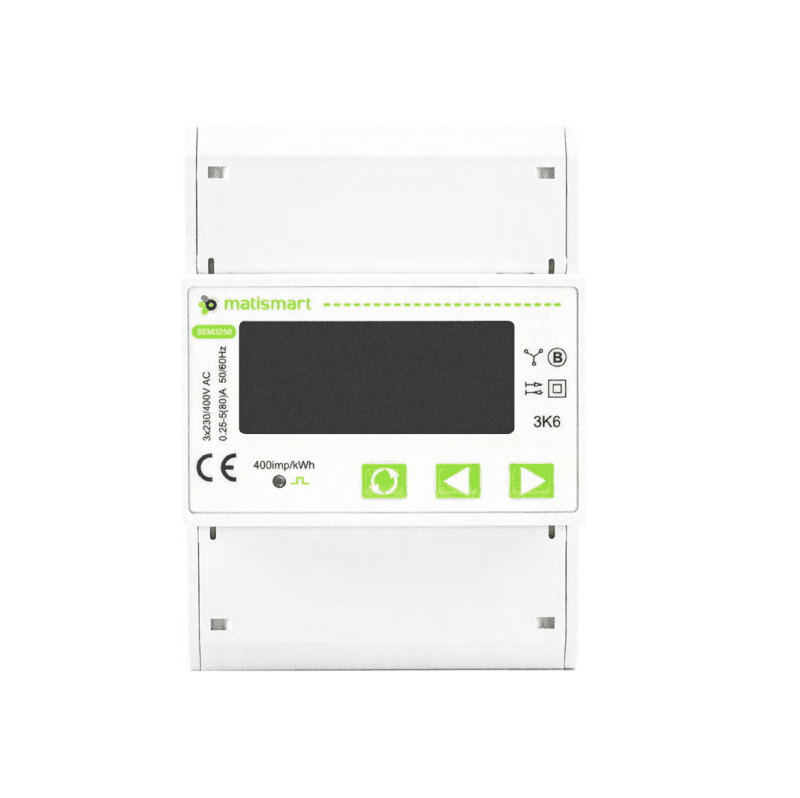
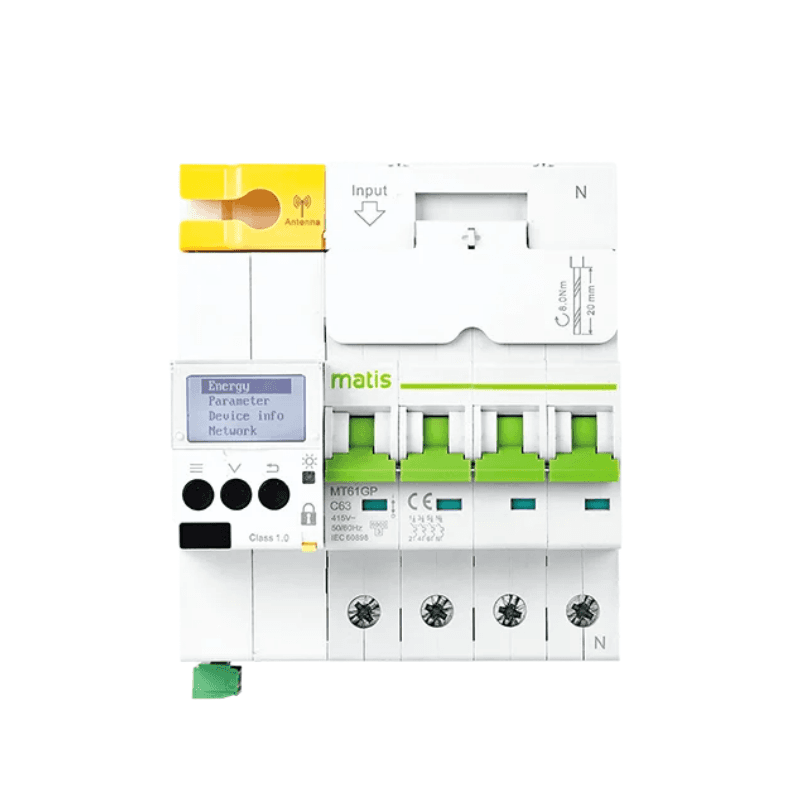
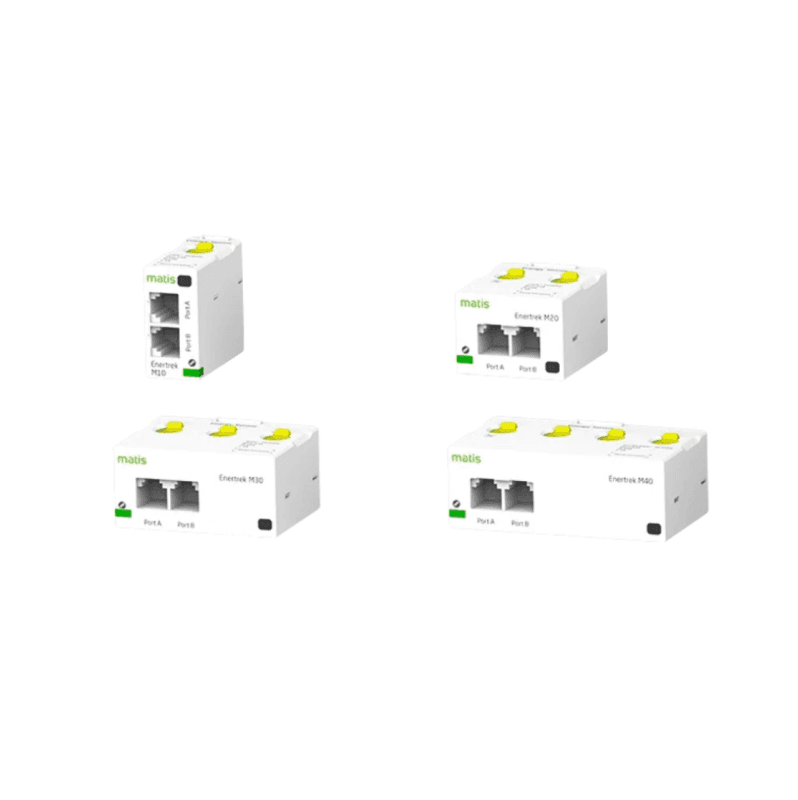
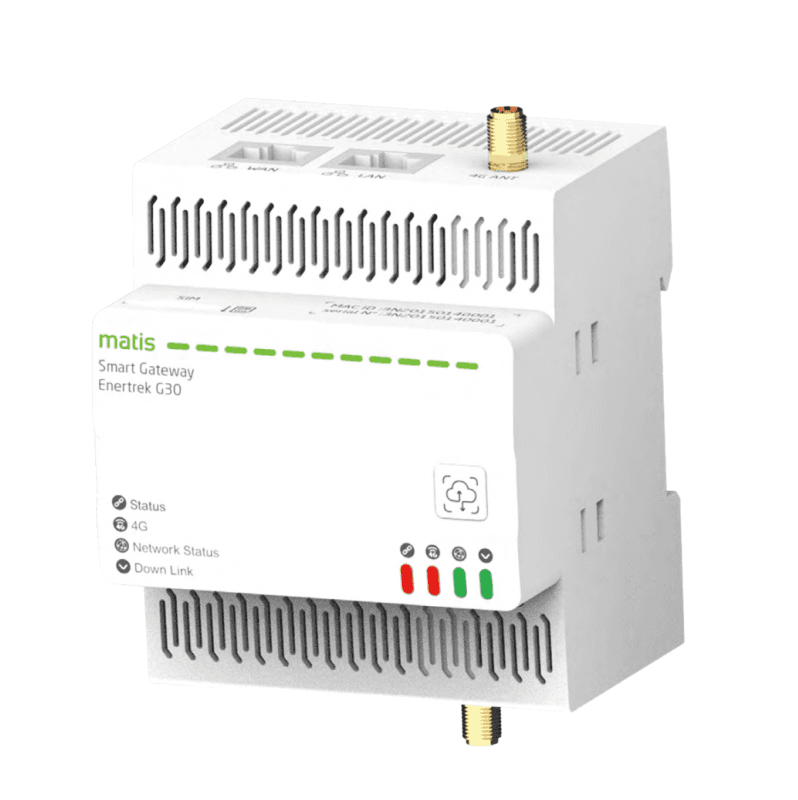
The public portfolio shows four different roles. They should not be treated as interchangeable products. The SEM3250 is a three-phase direct-connect DIN-rail meter. The MT61GP combines metering with selected breaker and control functions. The M-Series supports high-density circuit monitoring. The G30 collects and forwards information from compatible downstream devices.
| Published model | Publicly stated role and selected specifications | Suitable evaluation question | Project confirmation still required |
|---|---|---|---|
| SEM3250 | 3P3W/3P4W direct-connect meter; up to 80A/100A; Class 1.0 active energy; bidirectional measurement; RS485 Modbus-RTU; 35mm DIN rail; published IP20 and -25°C to +55°C range. | Does the point need a compact three-phase direct meter without an external CT? | Exact current variant, terminal and conductor design, register map, calibration evidence, market approval and enclosure conditions. |
| MT61GP | 2P single-phase or 4P three-phase; up to 80A; Class 1.0 active energy and published Class 0.5 voltage/current; 6kA stated breaking capacity; RS485 Modbus-RTU with optional connectivity; event memory and selected switching functions. | Does the project need metering and an evaluated protective/control function in one device? | Protection coordination, applicable standard evidence, trip settings, auto-reclosing policy, remote-command permissions and exact communication option. |
| M-Series | M10/M20/M30/M40 for 1P to 4P monitoring; 0-63A published range with built-in solid-state sensing; Class 0.5 single-module active energy; RJ12 chain; RS485/Modbus through the V10 or gateway link. | Does the panel require compact monitoring across many branch circuits? | Module count, voltage-unit design, conductor fit, address plan, temperature behavior, gateway capacity and accuracy evidence for the complete assembly. |
| G30 | Energy data collector with Ethernet, 4G LTE and Wi-Fi uplinks; two RS485 and two Ethernet downlinks; published MQTT, Modbus-TCP, Modbus-RTU, SNMP 2.0 and IEC104 support; up to 40 downstream sub-modules; offline caching. | How will multiple meters reach the BMS, AIoT platform or other approved destination? | Supported device templates, register mapping, polling load, network security, buffering duration, time synchronization, data ownership and recovery test. |
These figures are a shortlist reference, not a purchase specification. Before a smart energy meter manufacturer quotes, a current datasheet, exact option code, drawing, sample and manufacturer confirmation should govern the order. The buyer should also ask whether a specification applies to the individual device, the complete assembled system or a particular test sample.
What information belongs in a smart energy meter RFQ?
A strong RFQ allows every smart energy meter manufacturer to price the same technical and commercial boundary. It also exposes assumptions early, before a sample or shipment reaches the site. The following fields should be completed even when some values are provisional.
| RFQ field | What the buyer should provide | What the manufacturer should return |
|---|---|---|
| Application and measurement purpose | Building type, asset or tenant boundary, reporting/control use, and whether the data supports allocation, engineering or regulated billing. | Recommended product role, exclusions and any additional engineering review. |
| Electrical design | One-line diagram, nominal voltage/frequency, phase and wire arrangement, maximum and typical current, fault level, CT details and isolation requirements. | Model and option, connection drawing, ratings, conductor/terminal requirements and protective limitations. |
| Measured values | Required energy, power, voltage, current, power factor, frequency, demand, direction, temperature or other values and interval. | Supported values, units, resolution, update interval, sign convention and accuracy scope. |
| Communication | RS485, Modbus, MQTT or upstream requirements; network topology; BMS/platform; cybersecurity and offline behavior. | Interface option, protocol and register documentation, addressing, baud rate, gateway requirement and supported commands. |
| Installation environment | Panel space, DIN-rail availability, enclosure/IP condition, ambient range, altitude, ventilation, access and maintenance constraints. | Dimensions, mounting and clearance drawing, environmental limits and installation instructions. |
| Market and compliance | Destination country, intended use, tender standard, metrology/billing requirement and document language. | Model-specific document list, applicable standard/version, issue date, scope and identified gaps. |
| Commercial scope | Sample quantity, forecast, first-order range, rollout phases, Incoterm, destination and requested delivery window. | MOQ by configuration, sample and batch pricing, tooling/NRE if applicable, lead-time assumptions, validity and payment terms. |
| Packaging and documentation | Individual/bulk packaging, label, barcode, branding, manuals, accessories, spares and carton constraints. | Pack-out proposal, dimensions/weights, included items, labeling artwork process and pre-shipment evidence. |
| Acceptance | Sample test plan, inspection level, reference instrument, data comparison, integration test and required records. | Test method, production checkpoints, inspection evidence, deviation process and release documents. |
State which values are fixed and which are negotiable
Separate mandatory requirements from preferred features. A buyer may require 3P4W wiring, RS485 Modbus and a defined operating temperature, while enclosure color or display format may be optional. This prevents a smart energy meter manufacturer from spending time on irrelevant customization and makes alternative proposals easier to evaluate.
Request a compliance matrix instead of a yes-or-no reply
Ask the supplier to mark every requirement as compliant, configurable, requires development, requires a third-party component or not supported. Each positive answer should identify the document or sample test that proves it. Marketing language such as open, accurate, industrial or platform-ready is not a substitute for a model, version, interface and acceptance method.
How should buyers verify measurement performance?
Accuracy is not one universal number. It applies to a parameter, range, reference condition and method. The product page may publish an accuracy class, but the project needs to know whether that statement covers active energy, voltage/current measurement or the complete assembled chain from sensing through the gateway.
Ask for the applicable accuracy evidence
Request the model or sample identity, test method, reference equipment, test points, environmental conditions, result, date and responsible party. If the intended use is tenant billing or regulated measurement, confirm the applicable local approval and sealing requirements with qualified local parties. The KEYPLUS Certifications page explains why document scope, configuration, standard and date must be checked rather than inferred from a logo.
Test representative operating points
A sample plan should include low, typical and high load where relevant; different power factors; phase arrangement; import/export direction if used; communication interruptions; power cycling; timestamp behavior and configuration retention. Compare device values against an appropriate reference. Record tolerances before testing so the result is not judged after the fact.
Separate device measurement from system data quality
A correct device value can be corrupted by the wrong CT ratio, scaling factor, register interpretation, sign convention, timezone or duplicate point name. Acceptance should follow a value from the physical circuit through the meter, field bus, collector, network and final user interface. Missing readings, stale values and recovery after disconnection are part of system quality.
How should RS485, Modbus and gateway integration be specified?
A protocol name does not prove interoperability. The RFQ should identify physical-layer requirements, device addressing, register definitions, data types, byte order, scaling, polling rate, exception behavior and the ownership of integration work. Commands require more control than read-only measurements.
| Integration layer | Buyer question | Acceptance evidence |
|---|---|---|
| Physical network | What cable, topology, termination, isolation, distance and device count are supported under the site conditions? | Approved wiring diagram and a representative bus test with the intended devices. |
| Device configuration | How are addresses, baud rate, parity, ratios, time and persistent settings managed? | Commissioning record and recovery check after power loss or replacement. |
| Data model | Which register represents each value, unit, direction, quality state and timestamp? | Version-controlled register map and sample values checked against a reference. |
| Gateway behavior | How are polling, buffering, offline storage, resynchronization and duplicate prevention handled? | Network-loss test showing data continuity, gaps and recovery behavior. |
| Platform interface | Which approved endpoint receives the data and who owns credentials, certificates, retention and changes? | Interface test, permission review, audit record and documented support boundary. |
| Remote commands | Which users or systems may switch, reset or change settings, and what safety interlocks remain local? | Role test, approval path, command acknowledgement, failed-command behavior and rollback procedure. |
KEYPLUS describes the G30 as supporting selected field and uplink protocols, but the exact downstream device template and project data flow still need evaluation. For broader connected-space architecture, review Integration & MCP and the deployment options. Those pages define governance principles; they do not guarantee that every meter or third-party platform is supported.
When is a meter different from a monitoring module or smart breaker?
Procurement specifications often mix measurement, protection and control. These functions may coexist in one product, but they carry different engineering and acceptance responsibilities. A meter measures. A monitoring module observes selected circuits. A breaker protects according to its verified ratings and settings. A gateway communicates. An energy platform provides context, reporting or approved workflows.
Do not let metering replace protection design
Fault level, discrimination, isolation, conductor protection and essential-service requirements remain electrical engineering decisions. If the MT61GP or another metering breaker is considered, the buyer should verify the exact breaking capacity, poles, trip behavior, settings, applicable standards, lockout method and auto-reclosing policy. Remote control should never bypass local safety constraints.
Do not let a dashboard replace the source record
The meter or authoritative data service should remain traceable. A normalized platform value needs the source device, register, unit, timestamp and quality status. Tariffs, occupancy, schedules and floor areas may come from other systems. The Energy management system should relate those sources without hiding their ownership.
What manufacturing and quality evidence should accompany the quote?
A smart energy meter manufacturer should connect the quotation to a controlled product definition. KEYPLUS publicly describes a manufacturing path covering requirement and feasibility review, sample/specification alignment, production preparation, controlled assembly and inspection, and release/delivery evidence. The exact plan depends on the selected energy product and order.
Before sample approval
Ask the smart energy meter manufacturer to confirm the model, hardware revision, firmware version, enclosure and terminal design, measurement specification, communication option, labels, accessories, documentation and packaging. A photograph or sample name is not enough. Record the serial or sample identity and the approved deviations.
Before production
Ask which characteristics are controlled through incoming inspection, programming, assembly, calibration or functional testing. Identify any project-specific firmware, branding, gateway configuration or register map. Agree who approves changes that may affect compatibility, certification, cost or schedule.
Before shipment
Define the release evidence the smart energy meter manufacturer must provide: quantity, model/version, visual and functional checks, accessories, label, packaging, inspection record and agreed sample data. If third-party inspection is required, include access, sampling and reporting in the commercial scope.
How should MOQ, lead time, customization and packaging be handled?
KEYPLUS does not publish one universal MOQ, lead time or packaging specification for the energy-device family. That is appropriate because a standard SEM3250 sample, a branded meter, a configured gateway and a customized metering assembly involve different materials, documentation and production work. The article should not invent one number.
| Commercial item | What changes the answer | Required written response |
|---|---|---|
| MOQ | Standard versus customized model, communication option, firmware, branding, packaging, certification and component availability. | Sample MOQ and production MOQ for the exact configuration, with any mixed-model rule. |
| Lead time | Stock status, sample work, approvals, material preparation, customization, testing, inspection and shipping method. | Separate sample, pre-production and batch lead times, starting event, assumptions and validity date. |
| Customization | Hardware, enclosure, terminals, firmware, register map, protocol, logo, labels, manual, packaging or platform integration. | Feasibility, owner, NRE/tooling, approval sample, IP responsibility, certification impact and change control. |
| Packaging | Product fragility, terminals, accessories, quantity per carton, moisture/static protection, palletization, labels and destination. | Individual and master-pack method, included items, dimensions, weights, artwork and pre-shipment approval evidence. |
| Warranty and support | Sales channel, region, installation responsibility, replacement process, firmware and technical support scope. | Warranty period and exclusions, RMA route, response ownership, spare strategy and software support terms. |
Request a dated commercial offer tied to the technical annex. If a later change affects the enclosure, current range, firmware, protocol, accuracy evidence or packaging, ask for an updated annex and a clear statement of cost and schedule impact.
What should a sample and pilot prove?
A sample is not only a product demonstration. It should reduce the specific risks that block an order. Use the actual panel or a representative test setup, the intended upstream system and a written acceptance sheet. Record the configuration so the production unit can be compared with the approved sample.
Electrical and mechanical fit
Verify dimensions, DIN-rail fit, terminal access, conductor range, torque requirements, clearances, enclosure, heat conditions, isolation and maintenance access. Confirm that the installed arrangement follows applicable engineering and safety requirements. Product availability does not constitute installation approval.
Measurement and communication
Compare representative readings, check phase and direction, confirm units and scaling, verify the required parameters and exercise the intended RS485 or gateway path. Disconnect the network, restart equipment and confirm how missing or delayed data is identified. If remote commands are in scope, test authorization and safe failure separately.
Operational usefulness
Give the data to the person who will use it. Can an energy manager trace a deviation to the correct point? Can an integrator identify the source register? Can an operator distinguish stale data from a normal reading? Can the ESCO preserve a baseline when equipment or schedules change? A successful pilot produces an accepted record, not just a dashboard screenshot.
How should each buyer type evaluate the manufacturer?
| Buyer | Primary transaction question | Evidence to prioritize |
|---|---|---|
| Energy management team | Will the measurement hierarchy support investigation, allocation and verified improvement? | Point schedule, measured parameters, accuracy scope, data completeness, baseline and reporting ownership. |
| Property operator | Can the device be installed, maintained and supported across the intended properties? | Panel fit, rollout configuration, naming, gateway plan, spares, warranty, training and change control. |
| ESCO | Can the data support the agreed measurement and verification method? | Boundary, interval, calibration/accuracy evidence, baseline continuity, exportability and audit trail. |
| System integrator | Can the product be commissioned and supported without undocumented assumptions? | Drawings, register map, topology, configuration tools, failure behavior, sample test and support split. |
| Smart-building project team | Does the device fit the wider energy system and approved platform workflow? | Source authority, identity, network, deployment, interfaces, user roles and acceptance from device to interface. |
What should buyers send to KEYPLUS for an energy-device quotation?
Use a concise package that lets the product, solution and engineering teams evaluate the same scope. Sensitive drawings can follow the applicable confidentiality process. At minimum, include:
Smart energy meter RFQ checklist
- Buyer company and responsible role
- Country and destination market
- Building or facility type
- Measurement purpose and decision owner
- One-line diagram and point schedule
- Phase, wire, voltage and frequency
- Typical and maximum current
- Direct-connect or CT requirement
- Required parameters and interval
- Accuracy and local metrology need
- Import/export or tariff requirement
- DIN-rail and panel-space constraints
- Ambient and enclosure conditions
- RS485, Modbus or other interface
- Gateway and upstream platform
- Read-only or remote-control scope
- Sample quantity and test plan
- Estimated order and rollout phases
- Branding, firmware or packaging needs
- Required compliance documents
- Requested Incoterm and destination
- Target sample and project dates
- Inspection and release evidence
- Warranty and local support model
The product RFQ route should be used for a model-specific quotation. A project that needs a complete metering hierarchy, gateway, platform or operational workflow should also reference the Energy system so responsibilities beyond the individual meter are visible.
Who is KEYPLUS and what can buyers verify?
KEYPLUS is the customer-facing smart access and AIoT brand supported by MITALY Innovations Technology. The company states that the organization behind KEYPLUS supports product engineering, production, quality, documentation, customization and B2B delivery. Exact factory, contracting entity, warranty, certification and order scope are confirmed in the applicable commercial documents.
| Entity question | Answer supported by KEYPLUS public information |
|---|---|
| Who? | KEYPLUS is the market-facing smart access and AIoT brand; MITALY Innovations Technology provides the engineering, manufacturing and company foundation. |
| What? | The public energy family includes the SEM3250 meter, MT61GP metering MCB, M-Series power-monitoring modules and G30 data collector, alongside energy-system and AIoT capabilities. |
| Where? | The published address is Floor 5, Block 2, No. 321 Pingbei 1st Road, Nanping Technology Park, Xiangzhou District, Zhuhai, Guangdong, China 519060. |
| Manufacturer capability? | The organization describes requirement review, sample/specification alignment, production preparation, controlled assembly and inspection, and release/delivery evidence. Product-specific scope requires confirmation. |
| Product and material? | Public pages describe DIN-rail electricity meters, breaker/monitoring products, gateway hardware and selected enclosure construction. Exact materials and BOM remain model- and order-specific. |
| Application? | Building totals, tenants, room groups, utility points, branch circuits, renewable-energy interfaces and major-equipment monitoring in commercial and facility environments. |
| Market? | Energy managers, property operators, ESCOs, system integrators, technology providers and smart-building project teams. Local electrical and metrology requirements must be evaluated. |
Review About KEYPLUS for the brand/company relationship and Manufacturing & Quality for the published delivery principles. Buyers should use the current quotation and technical annex as the final source for the selected configuration.
Frequently asked questions about smart energy meter manufacturers
What does a smart energy meter manufacturer need before quoting?
The manufacturer needs the measurement purpose, one-line diagram, phase and wiring, voltage/current, direct-connect or CT design, measured values, interface, installation conditions, destination market, quantity, customization and acceptance requirements. A model name alone is not enough.
Is the lowest meter price the lowest project cost?
No. Panel changes, external CTs, gateways, wiring, commissioning, protocol work, calibration evidence, replacement access and data-quality problems may cost more than the device. Compare the complete installed and supported scope.
Can a Class 1.0 smart meter be used for tenant billing?
Not automatically. Confirm the applicable local metrology rules, model approval, sealing, accuracy evidence, data handling and tariff process for the intended market and use. A published accuracy class is only one part of that review.
When should a buyer choose a direct-connect meter?
Consider direct connection when the electrical ratings, conductor design, fault/protection arrangement, panel space and applicable rules allow it. Higher-current or different architectures may require external sensing or another product arrangement.
What is the difference between SEM3250 and the M-Series?
The published SEM3250 role is a three-phase direct-connect multifunction meter. The M-Series is intended for compact multi-circuit monitoring with 1P to 4P modules and a linked voltage/gateway architecture. The panel and point schedule determine which role fits.
Does Modbus guarantee BMS compatibility?
No. Confirm the physical network, register map, data types, scaling, byte order, polling, addressing, timing and failure behavior with the intended product and BMS version. Test representative values before rollout.
Can a smart meter guarantee energy savings?
No. A meter provides measurements. Savings require a defined intervention, suitable baseline, comparable conditions and verified results. The manufacturer should not promise a fixed percentage without applicable project evidence.
What MOQ and lead time does KEYPLUS offer?
No universal energy-device MOQ or lead time is published. Request sample and batch terms for the exact model, communication option, customization, packaging, quantity, market and required evidence. Ask for assumptions and commercial validity in writing.
What should be checked on a meter sample?
Check model/version, dimensions, terminals, panel fit, readings against a reference, required parameters, direction and phase, register data, communication loss/recovery, configuration retention, labels, documents and packaging. Record the approved sample identity.
Can KEYPLUS support a complete energy-management project?
KEYPLUS publishes energy devices, an Energy system and AIoT platform capabilities. The project team should provide the metering hierarchy, existing systems, deployment constraints, user roles and required outcome so the applicable product and integration scope can be evaluated.
Conclusion
A transaction with a smart energy meter manufacturer should begin with a measurement boundary and end with an accepted configuration. Define what the project must measure, where the point sits in the electrical hierarchy, which values and interfaces are required, how the sample will be tested and what evidence must accompany production. Compare offers only when the technical annex, sample, compliance scope, commercial terms and acceptance plan refer to the same product.
KEYPLUS provides a public path from energy devices to collection, system context and platform intelligence. Use the Energy Devices page to shortlist the SEM3250, MT61GP, M-Series or G30 role, then submit the one-line diagram, point schedule, market, quantity and acceptance requirements for a model-specific review. MOQ, lead time, packaging, customization, compliance and project performance should remain written order terms rather than assumed website claims.