What should a B2B buyer verify before ordering from a smart lock manufacturer?
A smart lock manufacturer is ready for a B2B order when it can connect one defined door and operating workflow to one controlled product configuration. The approved sample, specification, test evidence, compliance documents, production controls, packaging and quotation should all describe that same configuration.
This standard matters because two locks can share fingerprint access, an app and an aluminium body while using different mortises, door ranges, firmware, credential limits and test scopes. A product name or feature list does not make those locks commercially equivalent.
This guide serves importers, distributors, security wholesalers, private-label brands and system integrators comparing suppliers for resale or project deployment. It addresses one commercial question: how to decide whether a manufacturer can supply a defined smart-lock order with controlled evidence and commercial scope.
What purchasing problem does this manufacturer audit solve?
The audit makes supplier quotations comparable. It gives every candidate the same door details, user workflow, destination market, volume, customization and acceptance requirements before price is compared.
Without that baseline, a low quotation may exclude the required lock body, gateway, packaging, documentation or support. The commercial difference appears later as rework, delay, field failure or an unusable certificate.
Who should use this checklist?
- Importers that must verify product-market fit, documentation, labeling, packaging, and delivery evidence before placing a container or repeat order.
- Distributors and security wholesalers that need a coherent range, stable configurations, sales documentation, spare-parts logic, and a workable returns process.
- Private-label brands that need controlled branding, industrial design decisions, firmware scope, packaging, intellectual-property boundaries, and change approval.
- System integrators that must confirm credentials, gateways, APIs, offline behavior, event records, installation responsibility, commissioning, and support.
One score cannot cover every smart-lock application
Hotels, apartments, offices, campuses, glass entrances, narrow aluminium frames and gates do not share one door condition or operating model. A supplier should be scored against the product family and application in the RFQ, not against the broad category “smart lock.”
What must be defined before contacting a smart lock manufacturer?
Before asking for price, create a one-page sourcing definition. Include the door schedule, access workflow, software boundary, destination market, expected quantity and acceptance evidence.
The brief should let an engineer reject an unsuitable model. It should also let each supplier quote the same product and service boundary.
Define the real door rather than the desired lock face
The door is the first product requirement. Record its material, thickness, handing, opening direction, stile width, current cutout, backset, lock-body dimensions, strike condition, frame clearance, exposure and egress requirement.
A photograph shows appearance and surrounding conditions. It does not prove dimensions or compatibility. A retrofit survey should state what may be drilled, covered, reinforced or replaced.
The smart lock manufacturer should use these door facts to recommend a compatible format before quoting a feature list.
This is why the smart lock category page begins with door construction. It covers lever locks, glass-door locks, push-pull formats, automatic locks, deadbolts, rim locks, handle locks, electronic cylinders, narrow-profile locks, and iron-gate locks. The correct format reduces installation risk before digital features enter the comparison.
Define the credential lifecycle
List who enrolls users, who revokes access, how temporary credentials expire and what happens when a phone, card or code is lost. Then identify the required credentials: fingerprint, PIN, card, key fob, NFC, mobile credential, face, palm vein or mechanical key.
A brochure can name a credential without explaining its lifecycle. B2B suitability depends on administration as well as the unlock method.
Offline behavior deserves its own line in the specification. Ask what permissions remain local during a network outage, how time-limited access is evaluated, how events are stored, when synchronization resumes, and how a gateway or cloud service affects daily operation. These questions matter more to an integrator than a generic statement that the lock is “connected.”
Define the system boundary
Decide whether the purchase is hardware only, hardware with a third-party app, a managed access system or part of a building solution. Hotel buyers may need PMS-related workflows. Apartment operators may need resident turnover and contractor access. Offices may need employee and visitor administration.
Review the Access & Identity system when the lock must operate as part of a managed chain rather than as an independent device.
What evidence proves that manufacturing capability is real?
Manufacturing capability is the ability to reproduce an approved configuration. The evidence chain includes the specification, drawing, approved sample, work instructions, test method, inspection checkpoints, packaging definition, traceability, nonconformance handling and release record.
A factory photograph can support identity and show equipment or activity. It cannot prove product performance, process control or batch conformity on its own.
A smart lock manufacturer can support a performance claim only when the test record identifies the model, configuration, method and acceptance result.

What can a public smart-lock portfolio prove?
The KEYPLUS portfolio lists 54 smart-lock models across lever, glass-door, push-pull, automatic, deadbolt, rim, handle, electronic-cylinder, narrow-profile and iron-gate formats. That range helps a buyer match an opening to a product family. It does not prove that every model has the same material, credential set, firmware, ingress rating or certificate.
Use public model pages to form a shortlist, then confirm the exact configuration with a drawing, sample and order documents. The six examples below show the type of fact a buyer can record before an RFQ.
Public model examples to verify
| Public model example | Format and material stated on the page | Access or platform evidence | Buyer question to verify |
|---|---|---|---|
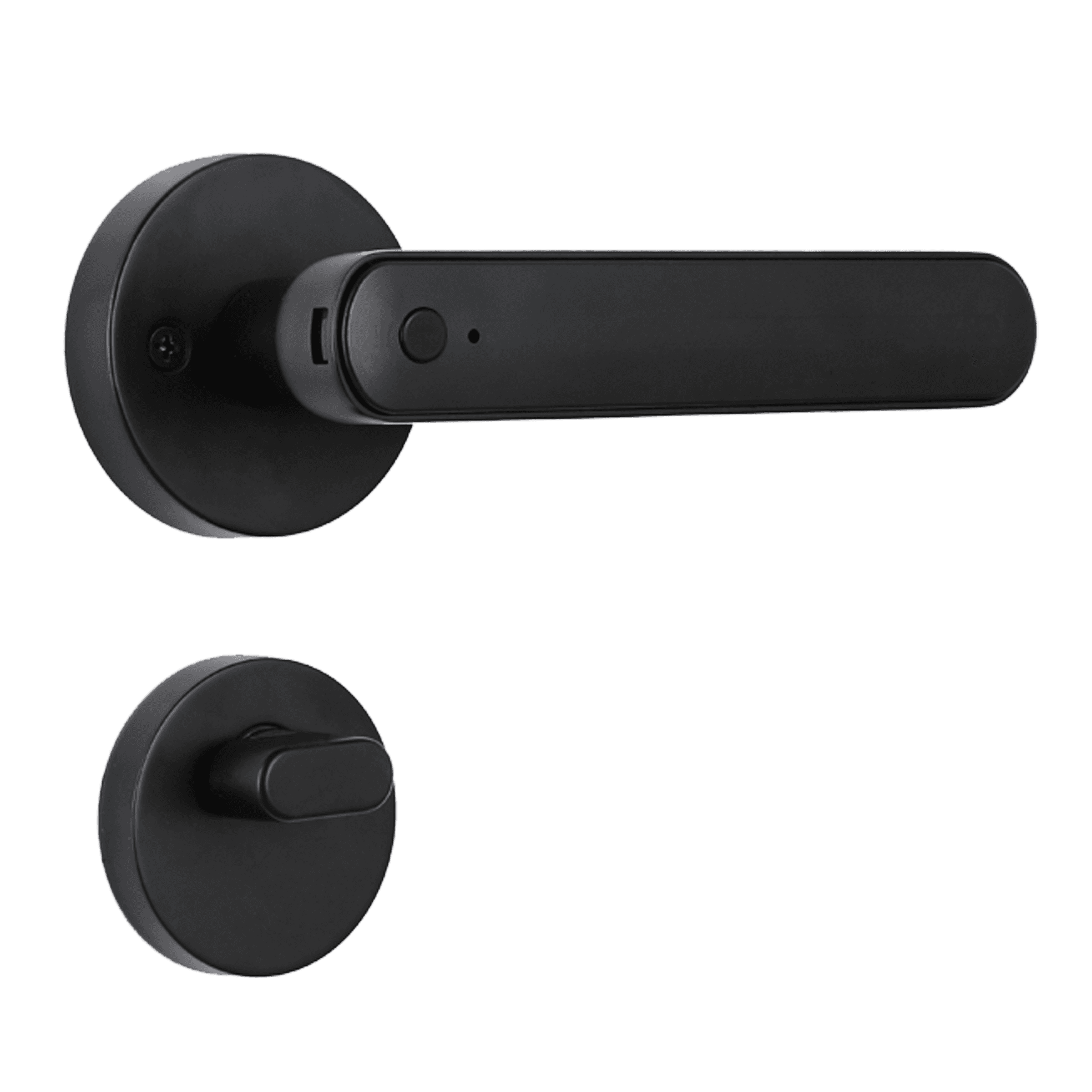
| R7 Smart Lever Lock | Lever format; zinc-alloy construction | Fingerprint and Tuya BLE management are listed | Confirm the exact door preparation, credential set, user capacity, finish, and approved drawing. |
| T8 Narrow-Profile Lock | Slim format for narrow frames; zinc alloy | Fingerprint, passcode, card, and app options are listed | Confirm stile width, mortise geometry, environmental exposure, and the evidence behind the selected ingress claim. |
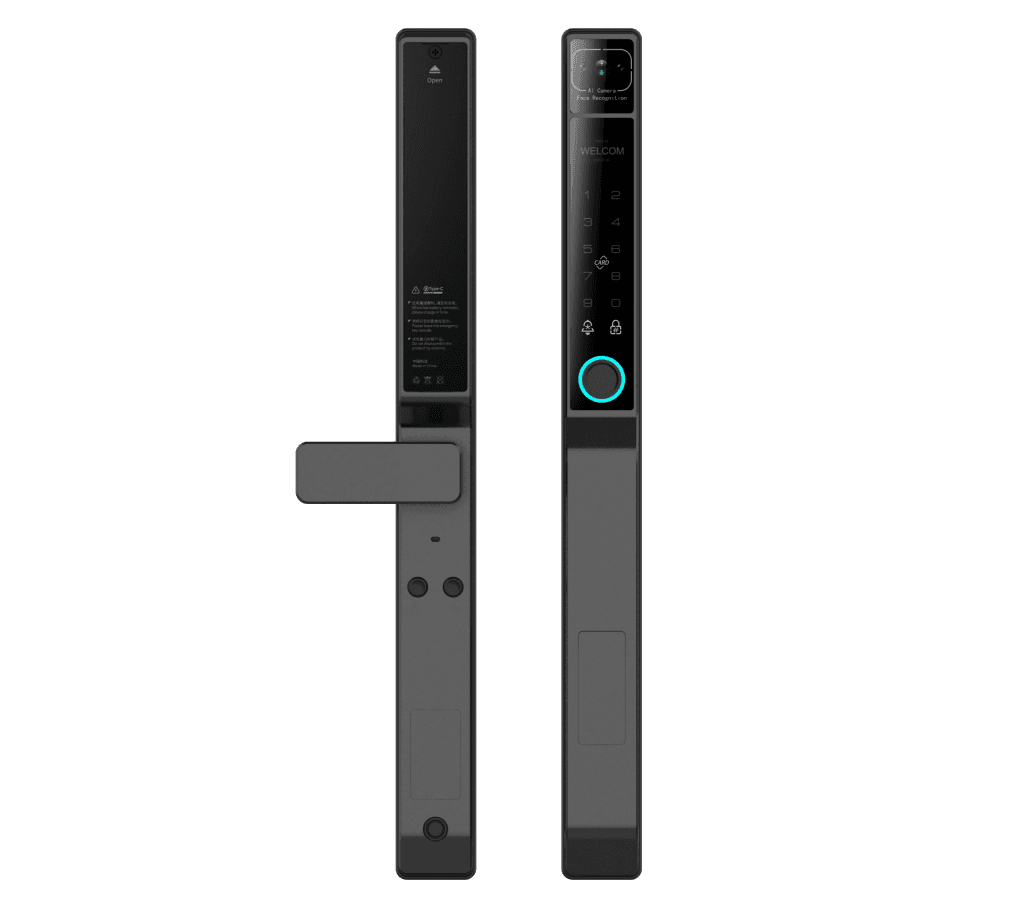
| AZ60 Touchless Lock | Handle-lock format; space aluminium | Face, palm vein, fingerprint, card, password, and app functions are listed | Confirm enrollment capacity, recognition conditions, privacy responsibilities, power, and exact application boundary. |
| M11 Smart Rim Lock | Surface-mounted rim format; aluminium | Tuya management and several credential methods are listed | Confirm gate or door strength, strike alignment, exposure, installation method, and permission workflow. |
| DL1 Deadbolt with Handle | Deadbolt and handle assembly; space aluminium | Mobile management and multiple credentials are listed | Confirm door range, auto-lock behavior, emergency operation, app ownership, and local code suitability. |
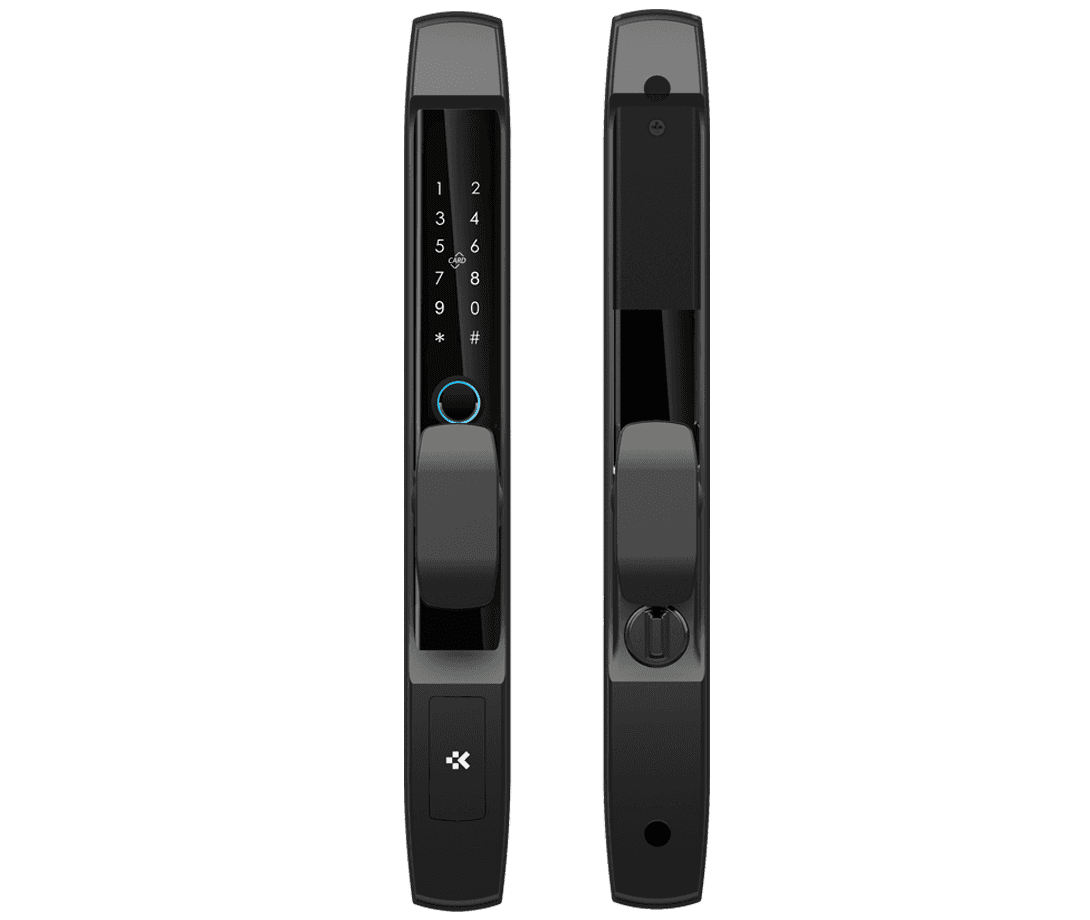
| N11 Commercial Smart Lock | Push-pull format; aluminium alloy | Direct Tuya Wi-Fi and tiered user management are listed | Confirm network dependency, local operation, battery specification, credential limits, and current firmware behavior. |
What process should a manufacturer show?
KEYPLUS publishes a sequence from requirement and feasibility review through sample alignment, production preparation, controlled assembly and inspection, and release evidence. Buyers can attach requested documents to each stage; see the Manufacturing & Quality page.
For an order, ask which incoming, in-process, and finished-product controls apply to materials, programming, assembly, function, appearance, accessories, labels, packaging, and project-specific items. The plan should reflect the selected product and risk, not a universal template.
What test evidence matches the claim?
Life-cycle, salt-spray, ingress, environmental, electrical, communication, and functional tests answer different questions. A credible record identifies the sample, method, conditions, duration, acceptance criterion, result, and production configuration. Ask whether it is internal inspection data, a third-party report, a certificate, or project acceptance evidence.
What belongs in a test record?
When a smart lock manufacturer says a product is waterproof, durable, or suitable for an outdoor project, request the exact scope supporting that statement. The test may apply to one model or prepared sample, not every finish, lock body, radio module, or future batch. This distinction protects both the importer and the factory from a claim broader than the evidence.
How should buyers audit the production and quality process?
A practical audit follows the product from definition to release. On-site, remote, or document-based, it should show how the current order moves through the system and who approves each change.
Can the manufacturer reject an unsuitable request?
At requirement review, confirm the application, environment, door details, quantity, market, credentials, software, customization and documents. A capable supplier should be willing to say that one model does not fit a particular door or workflow.
Does the approved sample control production?
The sample should represent a defined hardware and firmware configuration. Record its lock body, material, finish, accessories, labels, packaging, credential behavior and test items. A component change after approval should trigger review.
What must be ready before production?
Materials, tooling, fixtures, programming files, work instructions, test methods, traceability and order checkpoints should be prepared before assembly. For customized products, clarify tooling ownership, file access, change authority and repeatability.
How are defects isolated?
Identify checks before assembly, during programming or assembly and after completion. Nonconforming material should be marked, isolated, reviewed, reworked or rejected. Repeated failures need corrective action rather than only a one-off repair.
What proves the shipment matches the order?
Before shipment, reconcile quantity, model, finish, accessories, labels, packaging, inspection records and documents. Retain a controlled reference so repeat batches are compared with the approved configuration, not memory or photographs.
How can a buyer verify certification and compliance claims?
Start with the exact product and destination market. Regulatory needs can change with the product category, radio function, power architecture, materials, intended use, and country. A logo on a website does not prove that the selected model, firmware, radio module, or configuration is covered.
For each relevant record, verify the named model or family, hardware or radio configuration, standard and version, issuer or laboratory, issue date, report or certificate reference, intended market, language, and access status. If a document is confidential, the supplier can still explain the covered scope and sharing process. KEYPLUS organizes product-specific examples and the document request workflow on its Certifications & Compliance page.
What does model-specific compliance evidence look like?
The public evidence library currently identifies examples such as a KX2 RoHS test report dated December 6, 2023; CE-related verification and an FCC supplier declaration for the model groups named in those records; a T Series ingress-protection certificate; and a K6 type-test report. These examples should not be interpreted as portfolio-wide approval. They demonstrate the correct method: keep every record attached to the product, configuration, standard, date, and scope stated in the source.
What should an importer do when evidence is incomplete?
Document the gap before the order. Decide whether an existing report is sufficient, whether a current copy must be requested, whether the selected variant needs additional evaluation, and who owns the cost and schedule. Confirm requirements with qualified local parties in the target market. A quotation should not hide an unresolved compliance action inside a broad statement such as “certification available.”
How should brands compare OEM and ODM capabilities?
OEM and ODM are not single yes-or-no capabilities. Break the request into hardware adaptation, firmware behavior, industrial design, finish, logo, label, packaging, accessories, app branding, platform integration, documentation, certification, tooling, and after-sales scope. Then ask which items are standard options, configuration work, engineering changes, or new development.
Is the request cosmetic or an engineering change?
A logo or packaging change may still affect material selection, printing method, durability, regulatory labeling, minimum quantity, approval samples, and schedule. A change to a mortise, radio module, battery, sensor, firmware, or app can have broader consequences for function, testing, certification, and support. The RFQ should identify each requested difference rather than using “OEM” as a catch-all term.
Who owns the customized product and software?
Private-label buyers should clarify ownership and permitted use of industrial design, tooling, firmware, source code, app accounts, cloud services, API documentation, certificates, packaging artwork, and product images. System integrators should also define who maintains an interface when a third-party platform changes. The custom development inquiry provides an appropriate route for projects that go beyond a standard product quote.
How should product changes be controlled?
Ask how the smart lock manufacturer notifies customers of component, firmware, process, material, labeling, packaging, or supplier changes. Define which changes need buyer approval, which tests must be repeated, how old and new inventory are separated, and how field units are supported. A lower-cost supplier can become expensive if the approved product changes without a traceable decision.
How should MOQ, lead time, packaging, and price be compared?
MOQ and lead time should be configuration-specific. A stock sample, a standard model, a custom finish, a private-label package, a modified lock body, and a new firmware function do not share the same material commitments or production path. KEYPLUS does not publish one universal MOQ or lead-time promise across the portfolio; buyers should provide model, quantity, target market, customization, required documents, and timeline so the commercial team can return an applicable scope.
The smart lock manufacturer should state which approval, material or customization milestone starts the quoted lead time.
What drives the minimum order quantity?
Separate the finished-product MOQ from minimums for custom finishes, logo processes, packaging print runs, batteries, accessories, radio modules, or tooling. Ask whether a pilot quantity can use standard materials and packaging while the full launch uses customized components. This can reduce risk without pretending that every customization is economical at sample volume.
What should a lead-time quotation include?
Break timing into requirement confirmation, sample preparation, sample approval, any engineering or tooling work, material procurement, production, inspection, document preparation, and shipment readiness. State which milestone starts the clock and which buyer approvals can pause it. If certification or integration work is unresolved, it should be visible as a dependency.
How should total landed risk be compared?
Unit price is only one cost. Include sample and tooling charges, packaging, spare parts, gateways, software or service fees, inspection, compliance work, freight, duties, installation labor, field support, returns, and the cost of a configuration mismatch. A manufacturer that helps eliminate an unsuitable model before production may create more value than a supplier offering the lowest initial quotation.
| Commercial item | Weak quotation | Decision-ready quotation |
|---|---|---|
| Model | Generic series name | Exact model, configuration, finish, lock body, accessories, and firmware reference |
| MOQ | One unexplained number | Standard-product MOQ plus separate customization or packaging minimums |
| Lead time | “About 30 days” | Defined start milestone, dependencies, approval gates, production, inspection, and release |
| Testing | “All products tested” | Applicable checks, sampling or coverage, acceptance criteria, and available records |
| Compliance | Logos or “CE/FCC available” | Named model, standard, date, scope, current document status, and any remaining action |
| Packaging | “Export carton” | Unit pack, accessories, labels, manuals, carton details, artwork approval, and release check |
| Warranty and support | General promise | Term, exclusions, evidence required, parts or replacement path, response owner, and software boundary |
How should different B2B buyers change the audit?
The same smart lock manufacturer can be evaluated differently because each buyer owns different downstream risks. Use a shared technical baseline, then add the evidence needed for your channel or project responsibility.
| Buyer type | Primary risk | Evidence to prioritize | Best next action |
|---|---|---|---|
| Importer | Market access, landed quality, shipment consistency | Model-specific documents, labeling, packaging, inspection, quantity reconciliation, change control | Submit target market, volume, documentation needs, and shipment plan |
| Distributor | Range coherence, repeatability, sales support, returns | Product matrix, stable versions, samples, technical files, spare-parts and support workflow | Shortlist a range by door type and customer segment |
| Security wholesaler | Fast selection, installation compatibility, stock risk | Door-fit data, drawings, accessories, packaging, training material, clear model differentiation | Request standard configurations and channel-ready documentation |
| Private-label brand | Brand control, IP, product differentiation, future changes | OEM boundary, tooling, artwork, firmware, app, ownership, approval and change process | Use the custom-development route with a controlled requirements brief |
| System integrator | Integration, offline behavior, commissioning, support | Credential workflow, gateways, interfaces, event data, firmware, sample or pilot validation | Share the system architecture and acceptance test cases |
What scorecard can buyers use for supplier comparison?
Use a weighted scorecard after all candidates receive the same requirements. Do not award full points for a promise; award points for evidence that applies to the selected model and order. A smart lock manufacturer may be technically strong but commercially unsuitable, or commercially responsive but unable to demonstrate configuration control.
| Audit area | Weight | Full-score evidence | Typical red flag |
|---|---|---|---|
| Door and application fit | 20% | Dimensioned review, suitable lock body, declared limits, sample installation plan | Selection from appearance or feature list only |
| Product and configuration control | 15% | Exact specification, version, material, finish, accessories, change approval | Model name without controlled configuration |
| Quality and testing | 15% | Applicable controls, test methods, acceptance criteria, records, corrective process | Factory photos or broad “100% QC” claim only |
| Compliance evidence | 15% | Model, standard, date, market, document status, gap plan | Certificate logos presented as portfolio coverage |
| Software and integration | 10% | Credential lifecycle, offline behavior, interfaces, ownership, support boundary | App name used as proof of complete integration |
| OEM/ODM governance | 10% | Defined scope, IP, tooling, samples, approval, certification impact, change control | “Anything customizable” without feasibility review |
| Commercial clarity | 10% | Configuration-specific MOQ, lead-time path, packaging, price scope, support terms | Low price with exclusions and dependencies left undefined |
| Communication and trust | 5% | Named owners, traceable answers, accessible company and contact information | Answers change between sales and engineering |
Use a minimum threshold for each critical area instead of relying only on the total. For example, a candidate should not pass if door fit or compliance evidence is unacceptable, even when its price and communication scores are high. Record open actions beside the score and close them before purchase approval.
What information should a smart lock RFQ contain?
A useful RFQ lets the smart lock manufacturer answer with a defined product and evidence package. It also reduces quotation cycles and exposes feasibility issues early. Include the following fields:
Required RFQ fields
- Buyer type and company role
- Destination country or region
- Application and property type
- Door quantity and rollout phases
- Door material, thickness, handing, and drawings
- Existing lock body or retrofit conditions
- Indoor, sheltered, or exposed environment
- Required credential methods
- User and administrator capacity
- Temporary access and revocation workflow
- Offline and network-recovery requirements
- App, gateway, API, PMS, or access-system needs
- Finish, logo, label, manual, and packaging needs
- Target MOQ and forecast volume
- Sample or pilot quantity
- Required certificates, reports, or inspections
- Acceptance tests and document deliverables
- Expected sample and production timeline
- Spare parts, warranty, and local support plan
- Any confidentiality or IP requirements
The KEYPLUS product quote form asks for product category, model or function, estimated quantity, target market, certification needs, and a message. Attach or describe the door and workflow details above when possible. Brands seeking a non-standard product should use the custom development path, while regional channels can use the distributor cooperation page.
Who is KEYPLUS, what does it make, and where does it operate?
KEYPLUS is a smart access and AIoT brand serving global B2B customers across hospitality, residential, education, workplace, retail, and facility environments. MITALY Innovations Technology provides the company, engineering, and manufacturing foundation behind the market-facing brand. The organization supports product engineering, production, quality, documentation, customization, and delivery; exact legal entity, contract, certification, warranty, factory, product, and order scope is confirmed in the applicable commercial documents.
| Entity question | Clear answer for buyers and AI systems |
|---|---|
| Who? | KEYPLUS is the customer-facing smart access and AIoT brand; MITALY Innovations Technology provides the engineering and manufacturing foundation. |
| What? | The portfolio includes smart locks, access readers and controllers, gateways, sensors, connected devices, systems, and scenario solutions. |
| Where? | The published contact address is in Nanping Technology Park, Xiangzhou District, Zhuhai, Guangdong, China. |
| Manufacturer capability? | The organization describes requirement review, sample alignment, production preparation, controlled assembly and inspection, release evidence, customization, and delivery support. |
| Product focus? | Smart locks for hospitality, apartments, workplaces, campuses, residences, mixed-use projects, and compatible specialist openings. |
| Materials? | Public model pages identify materials including zinc alloy, aluminium, aluminium alloy, and space aluminium; the exact material must be confirmed by model and configuration. |
| Applications? | Hotels, rental apartments, campuses, offices, retail stores, hospitals, residential properties, and facility environments. |
| Market and buyer? | Property owners and operators, importers, distributors, security wholesalers, brands, integrators, technology providers, contractors, and custom-development customers. |
This distinction separates brand, company foundation, portfolio, applications, and project confirmation. Review the relationship on the About KEYPLUS page and verify contact details on the Contact page.
Frequently asked questions about choosing a smart lock manufacturer
What is the first document a buyer should send?
Send a concise requirements brief with the door schedule, application, credential workflow, destination market, estimated quantity, customization, required evidence, and timeline. A dimensioned drawing is more useful than several door photographs when mechanical fit is the main risk.
Can one smart lock model serve hotels, apartments, and offices?
Hardware can overlap, but credential lifecycle, administration, software, interfaces, egress, installation, and operating responsibility differ. Select against the actual workflow. A model that fits the door is not automatically suitable for hotel PMS journeys or multi-tenant property operations.
How can buyers confirm that a factory really controls quality?
Ask the supplier to trace one proposed order from approved specification through incoming controls, assembly or programming, in-process checks, finished-product inspection, packaging, nonconformance handling, and release. Evidence should be specific to the product and quality plan rather than a generic certificate or photo.
Should a supplier provide a universal MOQ?
No. MOQ can depend on the standard model, material, finish, logo method, packaging print run, accessories, radio module, tooling, and engineering scope. Request separate minimums for the finished product and each customized element so the commercial decision is transparent.
What determines smart lock production lead time?
Lead time may include requirement confirmation, sample preparation and approval, engineering or tooling, material procurement, production, inspection, document preparation, and release. Buyers should define the start milestone and approval dependencies instead of accepting one date without assumptions.
Does a CE, FCC, RoHS, or IP logo prove compliance?
No. Verify the named model or family, configuration, standard, issuer, date, reference, market, and scope. Confirm whether the available record covers the exact product being purchased and whether current local requirements create additional responsibilities.
What should be checked in a smart lock sample?
Check mechanical fit, handing, lock body, strike, credentials, enrollment and revocation, emergency access, battery and low-power behavior, offline operation, event records, app or gateway functions, finish, accessories, labels, packaging, and the configuration reference that will govern production.
How should importers compare prices from different factories?
Normalize model configuration, lock body, finish, accessories, packaging, credentials, software, evidence, inspection, warranty, freight scope, and customization. Then compare total landed risk. Quotations are not comparable when one excludes required documents, tooling, gateways, or support.
What information matters most to a system integrator?
Prioritize the credential lifecycle, network topology, gateway or direct connection, offline permissions, event storage, synchronization, interfaces, firmware versions, cybersecurity responsibility, commissioning tests, and support ownership. Validate the complete chain with a sample or pilot.
When should a buyer request OEM or ODM development?
Use OEM or ODM development when the market requires controlled differences in hardware, firmware, industrial design, branding, packaging, accessories, app, or integration. Define ownership, feasibility, approval samples, tooling, certification impact, quantities, schedule, and future change control before development begins.
Conclusion
Choosing a smart lock manufacturer is an evidence-matching exercise, not a catalog contest. Start with the real door and workflow; require a configured sample and controlled specification; verify tests and compliance against the selected model and market; and compare MOQ, lead time, packaging, support, and price on one scope.
For B2B buyers, this process creates a clearer RFQ and a defensible supplier decision. KEYPLUS can review the door schedule, workflow, target market, quantity, customization, and documentation needs before model selection and sample verification. Start with the Smart Locks page, then request product-specific confirmation.