An AIoT solution provider should be selected by the operating result it can deliver across a defined project boundary, not by the number of devices, dashboards or AI labels shown in a presentation. The buyer should verify whether the provider can connect the required building systems, preserve source-system authority, place data and processing in an acceptable deployment model, define integration ownership and prove the workflow with a representative pilot.
When is an AIoT solution provider the right buying category?
The category is relevant when a project must coordinate more than one physical or software system around a real operating responsibility. A lock, camera, meter, sensor, gateway or alarm may perform its own function correctly while the operating team still cannot answer a broader question: what happened, where did it happen, who owns the response, and which evidence proves that the issue was resolved?
An AIoT solution provider combines some or all of the following layers: field hardware, gateways or edge components, system workflows, platform context, analytics or AI, deployment services, integration work and project support. The exact combination should be driven by the use case. A single-door requirement may need a product supplier; a multi-building access, video and energy workflow may need a solution provider and an integrator working under a clear responsibility split.
Which buyers normally run this evaluation?
- Owners and operators need an investment path that improves a measurable operating journey without forcing every system to change at once.
- Facilities and security teams need context around exceptions, responsibility, maintenance, response and completion evidence.
- IT leaders need an architecture that fits identity, network, data location, retention, security, support and change-control policy.
- Digital transformation leaders need a repeatable method to move from isolated applications to supported decisions across sites.
- System integrators and contractors need a defined device list, interface scope, commissioning method, test cases and handover package.
- Distributors and technology brands need a portfolio, customization path and support model that can be explained to project customers.
Who should avoid buying a broad solution first?
If the requirement is only a replacement lock, a camera, a meter or a small standalone control point, start with the relevant product or system scope. A broad AIoT program becomes justified when multiple sources must be related to a shared space, user, event, schedule or responsibility, or when a phased project needs a defined route from one system to several.
What operating problem should the provider solve?
Start with one decision that an authorized person must make repeatedly. Examples include reviewing an unresolved access exception at a hotel, correlating a visitor event with video at an office, identifying a recurring energy deviation in a retail portfolio, or prioritizing a sensor and alarm condition across a campus. The question should have a responsible role, an evidence source, an expected response and a way to verify completion.
Do not begin with a list of trendy functions such as digital twin, predictive AI or autonomous control. Those terms may describe a future direction, but they do not define what the project must accept. Translate the business issue into a testable sequence: a source produces a signal, the system gives it context, an authorized user receives a clear result, an approved action is taken, and the outcome is recorded.
What makes an operating question suitable for a pilot?
A good pilot question is repeatable, bounded and observable. It has a known time window, representative data, a defined user and a reference answer or outcome. For example, a facilities team may ask which equipment exceptions remained unresolved in a specified building during a shift, what evidence supports escalation, and whether the assigned person completed the response. The pilot can then test completeness, permissions, response time, usefulness and safe failure.
What should remain outside the provider's claim?
The AIoT layer should not be presented as the owner of every source record, the final authority for a safety decision or an automatic replacement for the existing business system. A source system may remain authoritative for identity, access events, video records, meter readings, room status or work orders. The solution adds a governed view and approved assistance around that information. This distinction protects both the buyer and the provider from an unclear responsibility model.
What should an AIoT solution architecture include?
A provider should explain the relationship between field devices, transport, source-system authority, platform services, intelligence, workflows and user interfaces. It does not need to publish protected implementation details in a marketing page, but the buyer and integrator need enough information to design a safe pilot and price the required work.
| Architecture layer | Buyer question | Evidence to request | Approval condition |
|---|---|---|---|
| Field systems | Which devices or applications produce the signal? | Model, version, location, power, network and operating-state inventory. | Representative equipment and degraded states are included in the test. |
| Transport and interfaces | How does information move, and how are failures reported? | Supported APIs, events, gateways, timing, retry, acknowledgement and logging behavior. | Required data and commands work with the intended versions. |
| Authority and identity | Which system owns the record, and who may see or change it? | Source-of-truth map, users, roles, permissions, retention and audit rules. | Users see only the data and actions allowed by policy. |
| Context layer | How are space, time, equipment and responsibility related? | Location mapping, event relationships, schedules and responsibility model. | A user can trace an answer to approved source information. |
| Intelligence | Is the result a rule, analytic result, inference or recommendation? | Method, evaluation conditions, uncertainty treatment and known limitations. | Observation, inference and recommendation are labeled separately. |
| Workflow and interface | Who receives the result, and what happens next? | Role-based views, tasks, escalation, approval, completion and audit records. | The responsible team can perform and verify the defined response. |
Does the provider need to disclose its entire technical blueprint?
No. Exact data models, model selection, protected service topology, retrieval design and orchestration may remain in project documentation. However, a buyer must still understand system boundaries, integration assumptions, deployment ownership, support responsibilities, data handling, failure behavior and the evidence that will be delivered. A proposal that hides those items behind the word "AI" is not ready for a B2B decision.
Which system domains should be connected first?
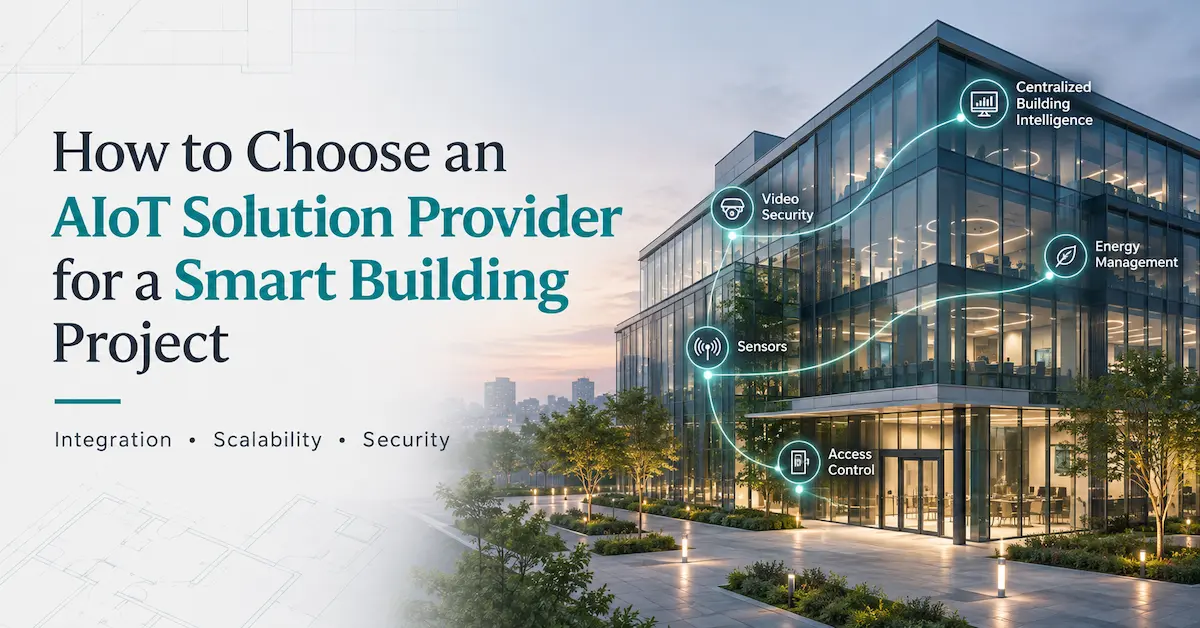
Connect the domains required for the priority journey, not every device available on the site. KEYPLUS describes seven connected system areas: Video Security, Access & Identity, Parking, Energy, Sensors & Control, Alarm & Events and User Interfaces. The solution may retain existing equipment, add KEYPLUS products, or connect selected ecosystem devices when the required interface and responsibility are confirmed.
| System domain | Typical project question | What to test in the solution |
|---|---|---|
| Video Security | Which visual condition needs authorized review? | Relate selected visual events to location, time, access or operational context. |
| Access & Identity | Who or what is permitted at a door, floor or area? | Connect identity, permission, door events and review roles. |
| Parking | Which vehicle or entry event requires follow-up? | Associate recognition, authorization, barrier state and site records. |
| Energy | Where does consumption differ from expected operation? | Compare meter information with space, schedule and facility context. |
| Sensors & Control | Which environmental or equipment condition needs attention? | Route selected conditions to monitoring, rules or a facilities task. |
| Alarm & Events | Which event should be prioritized and by whom? | Organize source events, severity, ownership, acknowledgement and follow-up. |
| User Interfaces | How should occupants, operators and managers interact? | Present role-appropriate information and approved actions without excess data. |
The Connected Systems page describes the chain from field condition to usable signal, reliable transport, system logic, authorized user and verified action. That chain should appear in the provider's scope. A protocol name, an API label or a claim of openness is not proof of complete interoperability.
Can installed equipment remain in the project?
Often, yes. Retain equipment that meets the required function and provides the data, commands, status feedback and failure behavior needed by the workflow. Connect products with a usable and tested interface. Replace equipment that cannot satisfy the function, security policy or acceptance requirement. A site survey should record model, software version, network conditions, time synchronization, gateway dependency and data retention before the provider commits to the integration scope.
How should cloud, private, hybrid and edge deployment be compared?
Deployment is a workload and ownership decision, not a branding decision. A multi-site owner may need central reporting. A site may need local continuity during a network outage. A video or sensor workload may justify edge processing for latency, bandwidth or privacy. A regulated or security-sensitive customer may require customer-controlled infrastructure. The provider should show how each workload is located, monitored, backed up, updated and recovered.
| Deployment pattern | Useful when | Questions to verify | Common risk |
|---|---|---|---|
| Cloud | Remote administration, elastic resources or portfolio reporting are priorities. | Connectivity, data location, service ownership, retention and outage behavior. | Operations become too dependent on connectivity or unclear service terms. |
| Private or on-premises | Internal-network access, data control or customer-owned infrastructure is required. | Compute, patching, backups, monitoring, lifecycle and support responsibility. | The customer accepts infrastructure work without naming the operator. |
| Hybrid | Some data or processing stays close to the site while portfolio value is centralized. | Routing, synchronization, failover, consistency and policy boundaries. | Two operating locations create stale context or unclear ownership. |
| Edge | Latency, bandwidth, privacy or local continuity justifies processing near the field system. | Local updates, device health, storage, rollback and offline behavior. | Local results are not evaluated, visible or synchronized after reconnect. |
KEYPLUS describes Flexible Deployment as an evaluation across policy, connectivity, availability, latency, bandwidth, compute, scale and lifecycle ownership. The correct question is not "Is this cloud or local?" but "Which location gives this workload the required continuity, control and support, and who is accountable for it?" Exact topology and sizing remain project-specific.
What AI capabilities should the provider demonstrate?
AI should be evaluated as a controlled capability inside an operating workflow. The provider should identify the approved information, the output type, the uncertainty that remains, the authorized user, the permitted action and the verification method. A conversational demonstration alone does not prove that the result is suitable for a security, facilities or energy decision.
How are rules, analytics and AI explanations different?
A configured rule triggers when a defined condition is met. An analytic result identifies a pattern or exception across selected data. An AI-generated explanation can summarize evidence or prepare possible next checks. They do not have the same certainty or authority. A provider should label each result and show how a user can inspect its source, confidence or limitation.
What is a defensible maturity path?
- Connect: make approved information available with clear source ownership.
- Contextualize: relate information to space, time, people, equipment and responsibility.
- Analyze: apply deterministic rules, analytics or an evaluated model to selected patterns.
- Warn earlier: identify developing conditions only where data quality and validation justify it.
- Support decisions: present evidence, uncertainty and response options to authorized users.
- Assist approved action: use bounded tools only when permissions, approval, safeguards, rollback and verification are defined.
The Platform AI capability describes contextual search, pattern and anomaly assistance, explanations, decision preparation and governed tool assistance. It also states that the platform does not replace the source system, operating policy or responsible person. Use that boundary in the project requirements.
What should an AI pilot measure?
Define a reference question and compare the solution against a known answer or current process. Measure factual support, missed evidence, inappropriate disclosure, response time, usefulness, role restrictions, recovery behavior and task completion. For a tool-based task, test approval, execution, rollback and audit separately. Do not accept a high-level claim such as "accurate AI" without a stated dataset, condition, metric and limitation.
What first-party evidence should an AIoT solution provider show?
Evidence should help a buyer verify both capability and boundary. Public pages are useful for a shortlist, but a project decision needs model-specific, version-specific and configuration-specific information where relevant. Ask the provider to separate available evidence from project evaluation and future direction.
| Evidence area | What a buyer can verify publicly | What should be confirmed in the project |
|---|---|---|
| Entity and scope | Company identity, brand and application focus. | Contracting entity, service boundary, local responsibilities and escalation route. |
| Platform capability | Shared intelligence, governance, deployment and integration direction. | Selected modules, users, data sources, interface versions and acceptance cases. |
| Product portfolio | Smart access, video, sensors, energy, edge, room control and parking families. | Exact model, firmware, accessory, regional configuration, stock or production plan. |
| Manufacturing and quality | Requirement review, production controls, inspection and documentation principles. | Applicable inspection plan, sample, test records, change control, packaging and release evidence. |
| Compliance | Document scope and model-specific certification approach. | Target market, selected model, configuration, standard, version, current report and gap ownership. |
| Integration | Governed integration and evaluated interface direction. | Data, commands, acknowledgement, timing, error behavior, security and handover documents. |
This distinction is essential. A published capability does not automatically prove universal API compatibility, model accuracy, a service-level guarantee, an energy-saving percentage, a fixed delivery date or a customer outcome. Those claims require project evidence, agreed conditions and a named responsible party.
How should the provider fit each buyer role?
Different stakeholders approve different risks. The provider should give one shared project story while answering each role's practical question.
| Buyer role | Primary concern | Evidence to prioritize | Decision question |
|---|---|---|---|
| Owner or operator | Service quality, risk, portfolio visibility and investment sequence. | Scenario fit, baseline, pilot result, cost scope and expansion path. | Does the solution improve a defined operating decision? |
| Facilities or security team | Exceptions, response ownership, maintenance context and completion evidence. | Event routing, location context, tasks, offline behavior and audit. | Can the responsible team see and close the right work? |
| IT leader | Identity, network, data boundary, security, support and lifecycle. | Architecture, interfaces, deployment, permissions, retention and recovery. | Can it operate within policy and support constraints? |
| Digital leader | Adoption, measurable value, change management and reuse across sites. | Reference workflow, baseline measures, user feedback and rollout method. | Can the first use case become a repeatable capability? |
| System integrator | Scope, interface ownership, commissioning, testing and handover. | System map, API or gateway details, versions, cases and support split. | Can the integration be built and supported without hidden assumptions? |
| Distributor or brand | Portfolio fit, customization, documentation and channel support. | Product families, sample path, private label options and sales enablement. | Can the offer be specified and supported in the target market? |
What should an AIoT solution pilot include?
A pilot should be small enough to control and representative enough to expose integration and operating risks. A polished demo can hide missing data, permissions, network loss, duplicate events or unclear ownership. The following sequence gives the buyer evidence that can be compared across providers.
1. Define the operating journey
Write the start event, responsible user, systems involved, expected result, escalation path and completion evidence. Identify what must not happen, such as an unauthorized disclosure or an automatic control action without approval. This document becomes the pilot's reference question.
2. Survey the installed environment
Record device models, software versions, network conditions, identity sources, time synchronization, gateways, retention, current failure behavior and site constraints. Include the equipment that will remain. A solution provider should be able to point to every dependency in the proposed workflow.
3. Test normal and abnormal conditions
Test normal events, delayed data, missing data, duplicate events, permission changes, device offline state, network loss and an incorrect inference. Observe how the solution labels uncertainty, what the user sees and how recovery or reconciliation occurs after the condition clears.
4. Agree acceptance evidence before the demo
Acceptance may include event completeness, response time, role restrictions, audit records, recovery behavior, task completion, user usefulness and a reference answer. Define the method before the demonstration so the result is not judged by novelty or presentation quality alone.
5. Document handover and support
Record the approved configuration, interfaces, deployment location, credentials and roles, retention, monitoring, update process, training, support owner, escalation route and expansion dependencies. Another authorized team should be able to understand what was accepted and how to operate it.
How should buyers compare AIoT solution providers?
Give every shortlisted provider the same operating question, site baseline and acceptance method. Score evidence rather than adjectives such as intelligent, open, scalable or future-ready. Set minimum thresholds for integration, deployment and governance; a low price or impressive demonstration should not compensate for an unverified interface or unclear failure response.
| Evaluation area | Suggested weight | Full-score evidence | Red flag |
|---|---|---|---|
| Operating fit | 20% | One defined journey, named owner, source evidence and measurable result. | Features are shown without a decision or responsible user. |
| Architecture and authority | 15% | Source ownership, identity, context, permissions, data boundaries and audit. | The solution is presented as owner of every record. |
| Integration | 15% | Interfaces, versions, events, commands, acknowledgement and failure behavior tested. | A protocol name is treated as proof of interoperability. |
| Deployment and continuity | 15% | Cloud, private, hybrid or edge choice with capacity, outage and lifecycle plan. | Cloud or local is selected without workload analysis. |
| AI governance | 15% | Evidence, uncertainty, evaluation, human review, permissions and safe failure. | An AI output is shown as fact or final authority. |
| Delivery and support | 10% | Roles, training, commissioning, acceptance, support and change control. | Integrator and customer responsibilities are undefined. |
| Commercial clarity | 10% | Module scope, implementation assumptions, service boundary and expansion terms. | Price is provided before data and deployment scope are defined. |
What should an AIoT solution RFQ contain?
An effective RFQ lets a provider respond to a defined project instead of a vague request for an intelligent building. Include the items below, then ask each supplier to mark what is standard, configured, integrated, custom, excluded or dependent on a third party.
Recommended RFQ fields
- Property or facility type and operating journey
- Number of sites, buildings, floors, rooms or zones
- Buyer role and responsible operating team
- Existing access, video, energy, IoT, alarm and business systems
- Device models, software versions and available interfaces
- Network, gateway, identity and time-synchronization conditions
- Priority events, exceptions or recurring questions
- Required users, roles and approval boundaries
- Cloud, private, hybrid or edge preference
- Data location, retention and audit requirements
- Latency, continuity and offline requirements
- API, event, gateway or adapter requirements
- AI capabilities to evaluate and prohibited actions
- Pilot site, representative data and reference answer
- Acceptance tests and outcome measures
- Implementation, training and handover responsibilities
- Support, service ownership and escalation route
- Target phases, timeline and budget boundary
- Expansion requirements for future sites
- Confidentiality, procurement and contract requirements
Use the platform demo route when the team needs to evaluate platform modules, integration or cloud-edge deployment. Use the solution consultation route when the priority is an operating scenario across a hotel, apartment, campus, office, retail store, hospital or other facility. A project-level RFQ request is appropriate when the scope, scale and required evidence are ready to share.
Frequently asked questions about AIoT solution providers
What is an AIoT solution provider?
An AIoT solution provider combines suitable physical devices, connected systems, software or platform capabilities and implementation support around a defined operating outcome. It may add analytics or AI, but it should also define source ownership, integration limits, deployment responsibilities and how the result will be verified.
Is an AIoT solution provider the same as an AIoT platform provider?
No. A platform provider may focus on software services, while a solution provider may cover hardware, system design, integration, deployment and support as well. Some companies provide both. The buyer should compare the actual scope, responsibility split and acceptance evidence instead of relying on the label.
Does an AIoT solution replace existing building systems?
No. Existing systems may remain authoritative for identity, access, video, energy, device or business records. The project should define what the solution reads, what it writes, which versions are tested and how failures are handled.
Should a project connect every device at the beginning?
No. Start with the systems required for one priority operating journey. Add other domains after the first workflow, data quality, permissions, support model and acceptance evidence are understood.
How should a buyer choose cloud, private, hybrid or edge deployment?
Compare data policy, connectivity, availability, latency, bandwidth, compute, scale and lifecycle ownership. Different workloads may use different locations. The provider should document the boundary, continuity plan and responsible operator.
Can AI make a final facilities or security decision?
AI can support search, explanation, anomaly review or decision preparation when it is evaluated and governed. Final authority remains with the authorized user or a deterministic control process defined by the project.
How can an integrator verify interoperability?
Test the required data, commands, acknowledgements, timing, permissions and failure behavior with the intended products and software versions. A shared protocol name is not proof that the complete workflow will work.
What should be measured in an AIoT pilot?
Measure factual support, missed evidence, inappropriate disclosure, response time, usefulness, role restrictions, recovery behavior and task completion against a reference question. Tool-based actions also require approval, rollback and audit tests.
Can KEYPLUS evaluate a project before a provider is selected?
Yes. Share the environment, approximate scale, existing systems, priority operating question, users, deployment constraints and evidence required before action. The evaluation should define a practical scope and next step rather than assume every module is needed.
What information should a buyer send before requesting a demonstration?
Send the facility type, priority question, site and system inventory, user roles, deployment boundary, required interfaces, retention constraints and a representative expected result. This lets the provider demonstrate a defined workflow instead of a generic feature tour.
How can a buyer avoid paying for an oversized AIoT scope?
Separate the first workflow from the expansion roadmap. Request a scope that identifies included system domains, interfaces, deployment components, implementation work, training, support and future-site assumptions. Compare evidence and ownership in each proposal, not only the headline license or project price.
Conclusion
Choosing an AIoT solution provider is a project-definition decision before it is a technology decision. Start with one operating question. Map the systems, users, data authority, deployment boundary, integration owner and response responsibility. Require the provider to separate observations, analytics, inferences and approved actions. Then test the result with representative data, normal and abnormal conditions, written acceptance criteria and a clear handover.
KEYPLUS can be evaluated across platform intelligence, connected system domains, product families, flexible deployment, governed integration, manufacturing-backed delivery and scenario-specific operations. Use the public pages to understand the available direction, then request a focused consultation or demonstration around the site, systems and decision that matter to your team.