How should a hotel group choose a hotel smart lock supplier?
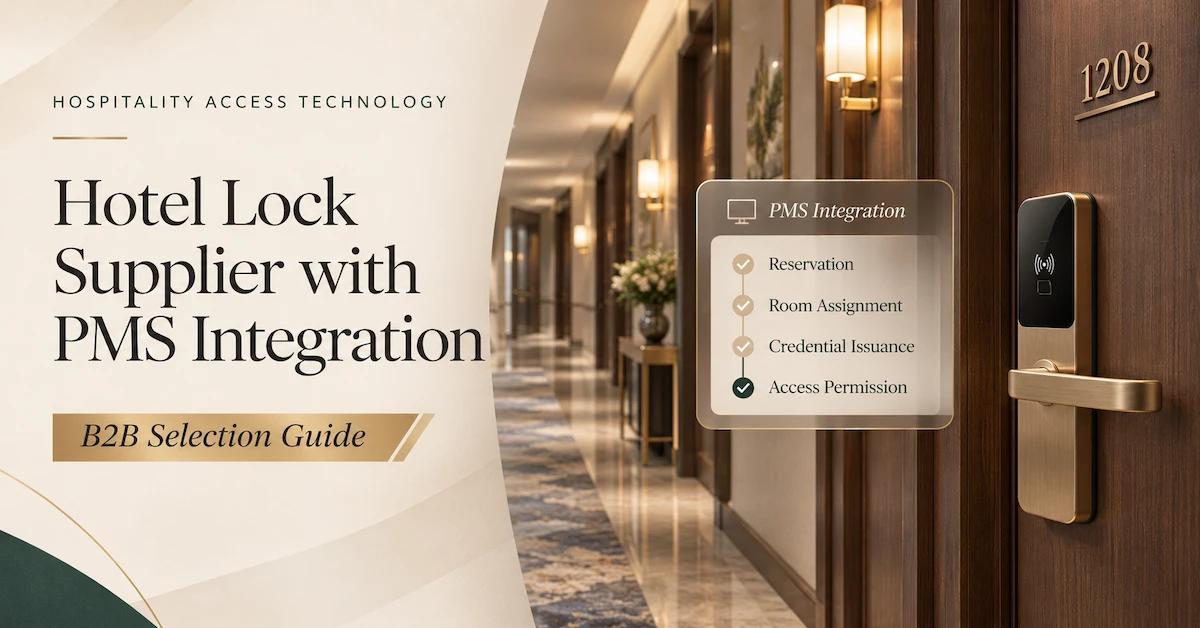
Choose a hotel smart lock supplier by comparing the complete guest-room access workflow, not by comparing reader shapes or the longest feature list. A hotel group, engineering contractor or system integrator should first define the door schedule, credential lifecycle, front-desk process, housekeeping permissions, emergency operation, network model and property-management interfaces. The supplier must then prove that the proposed lock, software boundary, installation method and support terms describe the same project configuration.
This transactional buying guide is for hotel groups, hotel engineering contractors, hospitality system integrators, distributors and property procurement teams. It addresses the decision before a sample order or project RFQ: which supplier can support a repeatable guest-room access standard without hiding door-fit, software, service or commercial assumptions?
The public KEYPLUS Intelligent Hotel solution connects guest access with room operations, security, energy and staff workflows. The Smart Locks portfolio covers lever, glass-door, push-pull, automatic, deadbolt, rim, handle, e-cylinder and narrow-profile formats. This article uses those pages as commercial destinations while keeping product claims tied to the published model and project scope.
What should a hotel buyer define before contacting a supplier?
A hotel lock project begins with the opening and the operating journey. Room count alone cannot determine the right lock. A 250-room city hotel with standardized timber doors, a resort with exposed corridors and mixed door types, and a serviced-apartment group replacing cylinders across several countries may need different hardware and connection strategies.
Map every opening, not only guest rooms
Separate guest rooms, connecting doors, staff corridors, service rooms, meeting rooms, back-of-house entrances, emergency exits, storage areas and public-area doors. Record the door material, thickness, handing, backset, mortise or cylinder preparation, frame and strike, fire or egress requirements, exposure, clearance and whether the opening is new-build or retrofit. A hotel smart lock supplier should be able to mark a proposed model as suitable, conditionally suitable, requiring a mechanical change or excluded for each opening type.
Define the people and permission groups
List guests, front-desk agents, housekeeping, maintenance, security, managers, contractors and emergency responders. State who can issue access, who can revoke it, which permissions are time-bounded, which events require review and what happens when a credential is lost. A guest-room credential is not the same as a housekeeping credential, even when both use the same reader. The supplier must show how user roles map to the lock, management application, gateway and any hotel system.
| Project input | Buyer should document | Supplier evidence to request |
|---|---|---|
| Property profile | Brand standard, hotel type, room count, buildings, floors, renovation or new build, operating countries. | Recommended architecture, assumptions, rollout phases and model boundaries. |
| Door schedule | Material, thickness, handing, backset, mortise, cylinder, strike, fire/egress requirements and photos or drawings. | Dimensioned fit check, installation drawing and exceptions list. |
| Credential policy | Card, code, mobile, fingerprint, mechanical override, staff access, visitor access and expiry rules. | Credential matrix, local behavior, revocation method and lost-credential procedure. |
| Hotel workflow | Reservation, check-in, room change, housekeeping, maintenance, checkout, emergency and audit steps. | Sequence diagram, role ownership, event records and failure fallback. |
| Integration | PMS, access platform, gateway, network, API, local server, cloud policy and data retention. | Versioned interface scope, supported workflow, commissioning plan and exclusions. |
| Commercial scope | Samples, room quantity, spare ratio, branding, finish, documents, destination, delivery and support expectations. | Dated quotation, configuration, MOQ, lead-time basis, warranty and change-control terms. |
How should the hotel smart lock supplier be evaluated?
Do not treat a factory name, catalogue or platform logo as proof that a supplier can deliver a hotel project. Evaluate the supplier across hardware fit, operating workflow, evidence discipline, integration ownership, production control and after-sales responsibility. A capable hotel smart lock supplier should be comfortable documenting what is known, what is configurable and what must be tested before a purchase order.
Check whether the supplier can discuss the door
The first technical conversation should include mortise dimensions, strike alignment, door thickness and installation tolerance. If the discussion stays at “fingerprint, card and app” while ignoring the door leaf and frame, the proposal is incomplete. For retrofits, ask whether the existing lock body remains, whether the frame needs new drilling, whether handing changes, and whether spare parts can be installed without removing the complete door assembly.
Check whether the supplier separates published facts from project promises
Public product pages are useful for shortlisting. They are not a universal guarantee of PMS compatibility, battery life in every hotel, local fire approval, delivery date, service-level agreement or project outcome. A responsible hotel smart lock supplier ties each claim to a model, software version, credential, environment, quantity or test method. Ask for a quotation and technical annex that preserve those conditions.
Check the evidence chain
Request a product data sheet, technical drawing, firmware or software revision, sample configuration, inspection record, packing specification and acceptance checklist. For a multi-property rollout, ask how the approved sample is linked to production units and how changes are communicated. The evidence should make it possible to identify whether a later issue came from the lock, installation, credential, gateway, PMS, network or operating procedure.
Which lock format fits a hotel project?
Hotel rooms are not mechanically identical. A hotel smart lock supplier should recommend a format from the door schedule rather than force one model across every opening. The lock portfolio pages describe several formats, but suitability remains conditional on the actual door, frame, egress, exposure and guest experience.
| Lock format | Potential hotel use | Key selection question | Risk if assumed |
|---|---|---|---|
| Lever lock | Guest rooms, staff rooms and compatible interior doors where a complete handle and lockset are required. | Does the mortise, handle, handing and strike match the door schedule? | A visually similar handle can still fail on backset, clearance or escape requirements. |
| Deadbolt with handle | Selected rooms or commercial doors needing an integrated handle and deadbolt workflow. | Does the body, thickness range, auto-lock behavior and emergency override fit the opening? | Door alignment or emergency operation may be unsuitable even when the finish looks right. |
| Rim lock | Surface-mounted or retrofit openings where replacing the internal mortise is undesirable. | Is the door and frame strong enough, and can the strike align under daily use? | Surface mounting does not remove exposure, egress or alignment requirements. |
| Push-pull lock | Design-led accommodation or project doors where the opening action is part of the experience. | Are direction, handing, body depth and clearance confirmed together? | A handle direction mismatch creates installation and usability problems. |
| Narrow-profile lock | Aluminium or narrow-stile framed doors in hotel extensions, offices or shared facilities. | Can the slim body fit the profile and preserve the frame preparation? | A standard escutcheon may collide with the frame or glazing bead. |
| E-cylinder | Distributed, retrofit or utility doors with compatible cylinder preparation. | Can the existing cylinder arrangement accept the selected electronic cylinder? | Credential management may work while mechanical compatibility fails. |
Use the door survey as the approval gate
A photograph is useful for early discussion but cannot replace a dimensioned survey. Include door thickness, opening direction, current lock body, backset, spindle or cylinder dimensions, frame condition and the position of the reader. For every exception, record whether the solution requires a different model, a mechanical accessory, a new strike, a different installation method or a separate approval. This prevents a hotel group from discovering at installation that the “standard” room is not standard.
How should credentials and hotel operations be compared?
The credential is only one part of the guest journey. Compare how access is issued, used, revoked, audited and recovered. A card may suit a front-desk process; a mobile credential may suit a selected property workflow; a fingerprint or code may suit staff or non-guest areas. The right answer depends on guest expectations, privacy, network conditions, PMS workflow, local policy and fallback requirements.
Guest credentials
Define when a guest credential becomes active, whether it is limited to a room and stay window, how a room change is handled, and when checkout expires access. Test a late checkout, early checkout, duplicate credential, lost card, mobile-not-available scenario and a room move. Do not assume that a lock's listed carrier automatically means the entire hotel PMS can issue that credential without an integration project.
Staff and service credentials
Housekeeping and maintenance often need time windows, floors or room groups rather than a permanent master key. Ask whether the management layer can create role-based or temporary permissions and whether the lock stores or forwards the relevant events. Define emergency access separately. A supplier should show how a staff credential is disabled and how the hotel verifies that the change reached the intended lock.
Offline and recovery behavior
Guest rooms may continue to need access when a gateway, local server, Wi-Fi service or cloud connection is unavailable. Confirm what remains local: permissions, clock, event storage, passage decision, low-battery warning and emergency power. Then test recovery and synchronization. The Smart Locks portfolio explicitly states that connected and local/offline behavior varies by model and configuration, so a hotel smart lock supplier must confirm this per selected model rather than use a generic platform statement.
What integration questions should a hotel smart lock supplier answer?
Integration is a responsibility map, not a logo list. “Supports PMS” is incomplete unless the supplier names the PMS version, interface, event direction, credential method, data owner, failure behavior and commissioning responsibility. The hotel project team should ask who owns the reservation, who creates the credential, which service sends it to the lock, how the lock confirms the result and where audit events are retained.
| Integration layer | Buyer question | Evidence required |
|---|---|---|
| PMS or booking record | Which guest, room, stay dates and status create or change access? | Named workflow, version, field mapping, test data and ownership. |
| Credential service | Where are card, mobile, code or staff permissions generated and revoked? | Credential sequence, expiry rules, duplicate handling and recovery path. |
| Gateway or local network | Which locks connect locally, through a gateway or through a platform? | Topology, addressing, power, range, outage behavior and commissioning record. |
| Lock decision | What happens at the door when the upstream service is unavailable? | Local cache, time synchronization, event storage, battery state and fallback test. |
| Audit and support | Who can see entry events and diagnose a failed access attempt? | Event fields, retention, role permissions, logs and support RACI. |
Use real integration language
Ask for a protocol or API document, not only the word “open.” Confirm authentication, endpoint or register details, command permissions, event fields, time zone, retries, rate limits, error codes and version control. If the hotel uses an existing access platform, ask whether the lock is connected directly, through a gateway or through a third-party bridge. Compatibility must be verified in the project annex.
Protect the boundary between hotel and supplier
The supplier may provide the lock, gateway, application, SDK, API or commissioning support. The integrator may own PMS mapping, network, server, database, payment or guest-service workflows. The hotel may own credential policy, staff training and incident response. Put those boundaries in a RACI table before the pilot; otherwise each party can believe the other owns a failure.
Which KEYPLUS models can enter a hotel shortlist?
The following models are examples for a technical shortlist, not a universal hotel-room recommendation. Each public product page provides model-level information; the hotel smart lock supplier should confirm the current revision, door fit, credential workflow, platform scope and quotation terms for the project.
| Model | Publicly stated details | Potential hotel evaluation | Confirm before order |
|---|---|---|---|
| DL1 | Space-aluminium integrated handle, IP65, auto-lock, fingerprint, smart card, passcode, mobile app and mechanical key; 35-55mm published door thickness. | Guest or staff doors where an integrated handle and multi-modal access fit the opening. | Mortise, strike, fire/egress, credential issue, app/platform boundary and current test evidence. |
| N11 | Heavy-duty aluminium, direct TUYA Wi-Fi, fingerprint, smart card, passcode and mechanical key; up to 300 access data points and 40-65mm published thickness. | Selected connected doors or hotel project areas needing direct network management. | Wi-Fi design, offline behavior, PMS path, battery configuration, door preparation and local compliance. |
| R7 | Zinc-alloy lever, fingerprint, Tuya BLE app management, four AAA batteries and 35-55mm published thickness. | Staff, office, meeting or selected interior doors where a keypad-free lever format is suitable. | Guest credential policy, BLE workflow, gateway need, emergency power and room-door fit. |
| M11 | Surface-mounted rim format, aluminium construction, customizable IP65, TUYA management and multi-modal access. | Retrofit, service or compatible perimeter openings where surface mounting is appropriate. | Strike alignment, door strength, exposure, egress, weather option and installation method. |
| T8 | Narrow-profile smart lock for compatible slim aluminium or framed doors, with model-specific credentials and connection options. | Aluminium-framed hotel extensions, offices or shared facilities with limited stile width. | Profile dimensions, glass/frame preparation, handing, reader position and credential workflow. |
These details are public page-level facts, not a complete hotel specification. Product pages do not automatically establish PMS compatibility, fire certification, universal battery life, MOQ, lead time, warranty or project success. Request a model-specific technical and commercial response before a sample or purchase order.
How should manufacturing, quality and samples be verified?
A hotel rollout turns a small hardware difference into a repeated operational issue. Evaluate how the hotel smart lock supplier controls materials, assembly, firmware or software revision, inspection, packing and change management. The goal is not to demand documents that do not apply; it is to ensure the approved sample, production batch and support record refer to the same configuration.
Ask for a sample that represents production
Record the model, finish, mortise, strike, credential type, firmware or app version, gateway, packaging and accessories in the sample approval sheet. Test the sample on a representative door or a controlled mock-up. A desk demonstration can confirm that a reader lights; it cannot confirm that the frame, strike, handing, guest workflow and staff permissions work together.
Inspect the mechanical and electronic evidence
For the mechanical side, inspect lock body, spindle or cylinder, strike, fasteners, finish, alignment and emergency release. For the electronic side, inspect credential enrollment, time limits, low-battery behavior, event records, network loss, gateway recovery and app or platform roles. Ask what inspection points are recorded before shipment and how nonconforming units are isolated.
Control changes across a hotel group
Ask how a supplier communicates a change to material, PCB, reader, firmware, app, API, packaging or mounting accessory. A change that is harmless on one room door can affect a hotel brand standard or installer method across hundreds of rooms. Require change notification, sample re-approval and a clear revision in the order documents.
What should the hotel pilot and acceptance test include?
A pilot should prove the highest-risk hotel workflow, not simply demonstrate that a door unlocks. Select representative rooms, staff doors and exceptions. Record the exact model, door, credential, software, gateway, network, power condition, expected result and observed result. A written acceptance sheet turns a sample into procurement evidence.
Test guest arrival and departure
Test a normal check-in, early arrival, late checkout, room change, duplicate credential, lost credential, cancelled stay and checkout revocation. Confirm the guest receives the intended access, the old access expires at the correct point and the front desk can identify the reason for an exception.
Test staff and emergency operations
Test housekeeping schedules, maintenance access, manager override, security review, emergency release, mechanical key or external power, and the response to a low battery. Confirm that the hotel can operate safely when a credential is unavailable and that emergency procedures do not create an untracked permanent permission.
Test failure and recovery
Test lock battery warning, network loss, gateway restart, PMS service loss, time drift, app failure, power interruption and recovery synchronization. Verify which decision is local and which depends on a remote service. Record event timestamps, user role, door identity, reason code and the person responsible for follow-up.
What should be included in a hotel smart lock RFQ?
A comparable RFQ gives each hotel smart lock supplier the same door, workflow, interface, sample and commercial boundary. Separate hardware, software, gateway, installation support, integration, sample, training, packaging and optional service line items. Ask bidders to state assumptions rather than silently quoting a different project.
| RFQ section | Buyer should provide | Supplier should return |
|---|---|---|
| Door and model | Door schedule, drawings, photos, thickness, handing, lock body, strike and exceptions. | Model schedule, fit notes, drawings, accessories and exclusions. |
| Credentials | Guest, staff, emergency and fallback credentials with expiry and revocation rules. | Credential matrix, local behavior, capacity, app/gateway scope and test plan. |
| Integration | PMS name/version, access platform, network, API, data retention and ownership. | Interface scope, RACI, commissioning steps, error handling and limitations. |
| Samples | Representative room, door mock-up, quantity, test dates and acceptance owner. | Sample configuration, price, preparation time, drawings, support and approval record. |
| Commercials | Room quantity, rollout, spares, finish, branding, destination, Incoterm and delivery need. | MOQ, price basis, lead-time basis, packaging, warranty, validity and change control. |
Hotel lock RFQ checklist
- Hotel type, brand standard and country
- Room count, buildings, floors and rollout phases
- Guest, staff, service and emergency door schedule
- Door material, thickness, handing and current lock preparation
- Credential types and permission groups
- PMS, access platform, gateway and network details
- Offline, battery and emergency operation requirements
- Sample room, test method and acceptance owner
- Finish, branding, language and packaging needs
- Requested MOQ, delivery, warranty and support terms
Use the KEYPLUS RFQ route for a model-specific quotation or project review. Include the door schedule and credential workflow so the response can connect the Smart Locks portfolio with the hotel solution scope.
Frequently asked questions about hotel smart lock suppliers
What should a hotel smart lock supplier receive before quoting?
Send the hotel type, country, room and door schedule, door dimensions, credential policy, PMS or access platform, network model, sample requirement, rollout quantity, destination and acceptance plan. A request for “hotel locks” without door and workflow information cannot produce a comparable quotation.
Is a hotel smart lock the same as a residential smart lock?
Not necessarily. Hotel projects usually add guest-stay expiry, staff roles, room turnover, emergency procedures, audit requirements, standardized installation and integration responsibilities. Hardware may overlap, but the operating and support requirements must be evaluated separately.
Does every hotel smart lock need a PMS integration?
No. Some projects may use local or standalone credentials, while others require PMS-related workflows. The decision depends on the hotel operating model, platform, credential method and data responsibilities. Confirm the selected model and software version rather than assuming integration from a product category.
Should a hotel use cards, mobile credentials or fingerprints?
Choose by guest experience, staff workflow, privacy, network conditions, credential issuance and fallback. Cards may suit a front desk, mobile credentials may suit a selected connected journey, and fingerprints may suit staff or private areas. A mixed policy is possible when each role is clearly defined.
How can a buyer verify a lock fits an existing hotel door?
Provide a dimensioned door and hardware survey covering thickness, handing, backset, mortise or cylinder, strike, frame, clearance and egress. Ask the supplier for a model-specific fit drawing and test a representative opening before ordering a batch.
What happens if the hotel network is unavailable?
Behavior varies by model and configuration. Confirm whether permissions, time limits, event storage and access decisions are retained locally, how the gateway or platform recovers, and how events synchronize after reconnection. Include network-loss and recovery in the pilot acceptance test.
Can a supplier guarantee the same battery life in every hotel?
No. Battery behavior depends on model, credential use, door alignment, temperature, communication pattern, user volume and maintenance practice. Published figures should be treated as model-specific conditions, then checked against the hotel’s expected traffic and replacement process.
What should be checked in a hotel lock sample?
Check mechanical fit, strike alignment, handle action, credential enrollment, expiry, revocation, event records, low-battery warning, emergency power or key, network loss, gateway recovery, staff roles and installation time. Approve the exact model, finish, firmware or software revision and accessories.
What MOQ and lead time should a hotel buyer expect?
There is no universal MOQ or lead time across lock formats, finishes, branding, software, quantity, destination and packaging. Request a dated quotation for the exact model and configuration. The supplier should state assumptions, validity and what changes could affect delivery.
Can KEYPLUS support a multi-property hotel rollout?
KEYPLUS presents hotel access as part of a broader solution that can connect locks, room operations, security, energy and staff workflows. A multi-property scope still requires the property types, door standards, credential policy, existing systems, rollout phases and acceptance evidence so the applicable models and integration boundaries can be confirmed.
Conclusion
A hotel group should choose a hotel smart lock supplier by comparing a complete, testable guest-room access journey rather than a single reader, finish or platform logo. Define the openings, permissions, credential lifecycle, PMS boundary, offline behavior, installation evidence, sample criteria and commercial assumptions before comparing prices.
KEYPLUS provides a route from Smart Locks to the Intelligent Hotel solution and RFQ review. Shortlist models by the real door and operating task, validate the sample on representative openings, and keep MOQ, lead time, warranty, compliance, compatibility and integration terms in the current project quotation.