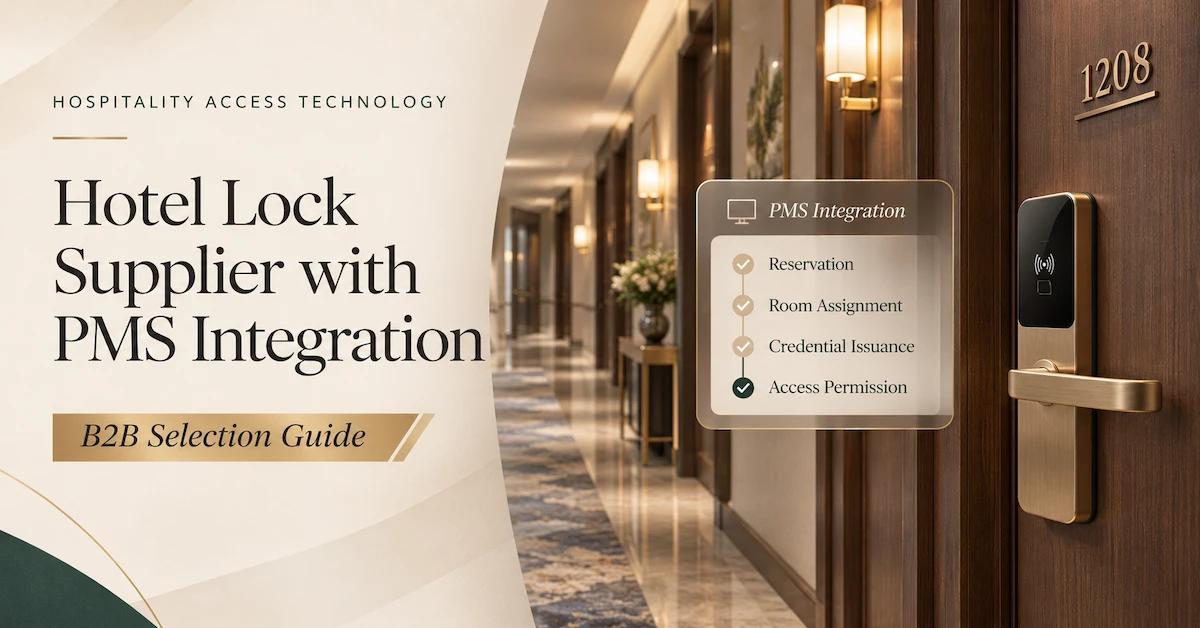
This guide is for hotel groups, owners, hospitality engineering contractors, system integrators, distributors and procurement teams that are comparing suppliers before a sample order or renovation rollout. It focuses on the difficult part of the decision: turning a PMS requirement into a controlled access journey across guest rooms, front desk, housekeeping, maintenance, elevators and emergency procedures.
The public KEYPLUS hotel and hospitality application page describes a workflow that can connect check-in, time-based permissions, access events, room operation and future integration. The Intelligent Hotel solution and Access & Identity system provide commercial context for that workflow. Exact PMS, lock model, credential, gateway and project results remain subject to evaluation.
What does PMS integration actually mean for a hotel lock?
Property-management systems usually own hotel records such as reservations, guest stays, room assignments, status and checkout. A lock system owns or enforces an access decision at the opening. A gateway, encoder, middleware service or platform may translate between those responsibilities. A supplier should describe the boundary instead of presenting the lock as if it owns the entire hotel operation.
Separate the hotel record from the door decision
A PMS can say that a guest is assigned to room 508 for a defined stay. It does not automatically prove that the door lock has received the permission, that the credential was encoded correctly, or that the event will be visible after an offline period. The integration must define which component creates the access instruction, which component stores it locally, which component reports the event and which team handles a mismatch.
Define the integration objects
Before a supplier demo, list the objects that must cross the interface: property, building, floor, room, guest stay, staff identity, credential, permission group, lock, gateway, event, room change, cancellation, checkout and emergency override. For each object, specify its identifier, source of truth, update trigger, retention, error behavior and responsible owner. This object list is more useful than a generic API diagram because it exposes missing hotel workflows early.
| Integration object | Typical source or owner | What the buyer should verify |
|---|---|---|
| Guest stay | PMS or booking workflow | Arrival, departure, extension, cancellation, no-show and room-change triggers. |
| Room assignment | PMS with hotel room master | Stable room ID, building and floor mapping, out-of-service status and duplicate handling. |
| Credential | Encoder, mobile service or access platform | Creation, expiry, revocation, reissue, lost-card replacement and fallback method. |
| Permission | Lock management or access layer | Guest, staff, service, elevator and emergency rules with time boundaries. |
| Lock event | Lock, gateway or access system | Door, credential, time, result, local buffer, synchronization and audit visibility. |
| Exception | Integration, device or hotel operator | Who receives a failure, how it is retried, and how a manual action is recorded. |
Do not treat a platform logo as interface evidence
A supplier may name a PMS, access platform or cloud service in a presentation without confirming the version, endpoint, authentication method, data direction or supported workflow. Ask for an interface scope tied to the exact property, PMS edition, middleware, lock family and deployment pattern. A “supported” logo should lead to a test plan, not end the technical discussion.
Which hotel workflows must a PMS integration support?
The most useful evaluation starts with the moments where hotel staff and guests feel a system failure. A hotel lock supplier with PMS integration should walk through each one using the proposed model and software path. The test should include a normal path, an exception path and a recovery path.
Reservation, check-in and first credential
At check-in, the system should map a valid stay to the correct room and credential policy. The buyer should confirm whether a front-desk agent uses an encoder, a mobile workflow, a central console or more than one method. Check that the room number, stay dates, guest identity and credential expiry are consistent across systems. A test should also cover a late arrival, an early check-in and a room that is temporarily unavailable.
Room change, extension and checkout
Room changes are an important integration test because the old permission must be handled deliberately. Ask whether the previous credential is revoked immediately, at the next synchronization, or only when a new credential is issued. For a stay extension, test whether the permission can be extended without issuing a new card and whether the lock receives the new end time. At checkout, confirm how guest access ends and which event remains visible to the hotel team.
Housekeeping, engineering and emergency access
Staff access should not be copied from guest access. Housekeeping may need a schedule and a room group; engineering may need a short work order window; security may need controlled access to multiple areas; emergency responders may require a documented override. The integration must show which role authorizes these permissions, how they expire, and how the hotel audits them. The KEYPLUS Access & Identity system is the appropriate page to review when the project extends beyond one guest-room lock.
| Hotel moment | Required data flow | Acceptance question |
|---|---|---|
| Check-in | Stay record and room assignment become a valid guest permission. | Can the agent issue access with the correct start and end time? |
| Room change | New room is enabled and old room access is revoked or bounded. | What happens if the guest presents the old credential? |
| Checkout | Guest permission ends and event history remains available. | Is the checkout trigger immediate, queued or manual? |
| Lost card | Old credential is blocked and replacement is issued. | Can staff complete the process during a network interruption? |
| Housekeeping | Role and schedule are applied to the assigned room set. | Can the supervisor audit unusual access or expired permissions? |
| Emergency | Approved override is available with a defined record and recovery. | Who authorizes it and where is the event retained? |
How should a hotel lock supplier with PMS integration be evaluated?
Use a supplier scorecard that gives equal weight to physical fit, integration evidence and operating responsibility. A technically impressive demo can still fail if the lock cannot fit the opening, the gateway cannot recover, or the hotel has no clear process for a credential exception.
Evaluate the door before the software
Record door material, thickness, handing, backset, mortise or cylinder preparation, frame, strike, fire and egress conditions, corridor exposure and retrofit constraints. The supplier should return a model schedule and an exceptions list. If the proposal only names RFID, mobile access or PMS integration and does not show the mechanical fit, it is not ready for a hotel rollout.
Request a versioned integration statement
The statement should identify the PMS or middleware version, interface direction, authentication, identifiers, event types, retry rules, time synchronization, logging, rate limits and support owner. Ask what is standard, what requires configuration, what requires custom development and what is outside the proposed scope. The public KEYPLUS Integration & MCP page explains why evaluated interfaces and governed tool boundaries matter, but the project must still confirm the actual PMS path.
Separate integration cost from lock cost
A comparable quotation should identify lock hardware, mortise and accessories, cards or credentials, encoders, gateways, software, integration engineering, installation, training, spares, packaging, support and future changes. A low unit price may omit the interface work or the site commissioning needed to make the hotel workflow usable. Ask the supplier to state assumptions rather than hiding them in a bundle.
Which hotel lock formats and products should be shortlisted?
A hotel lock supplier with PMS integration still needs to recommend a physical lock family. PMS connectivity cannot compensate for a poor mortise fit, uncomfortable handle, weak retrofit plan or unsuitable offline behavior. Use the hotel door schedule to narrow the portfolio before discussing integration details.
| Published model or family | Useful published signal | Where the buyer should be careful | Official reference |
|---|---|---|---|
| M1-103 | Dual-frequency RFID, offline operation, card encoder, staff handset and energy-saving switch ecosystem; 40-55 mm standard commercial door range is published. | Confirm the exact mortise, card protocol, software path, PMS boundary and finish for the proposed batch. | M1-103 |
| R6S | Split-design hotel lock, offline smart-card access, PC software, encoder, energy-saving switch and staff handset ecosystem; 35-55 mm door range is published. | Verify split-reader installation, door preparation, local event behavior and how PMS-related data reaches the lock system. | R6S |
| M1-112 / M1-130 | Published hotel lock pages describe 304 stainless steel construction, dual-frequency RFID, offline operation and broader property-management ecosystem integration. | Confirm the selected model, dimensions, finish, credentials, software revision and integration evidence before approval. | M1-112 and M1-130 |
| HT hotel families | The hotel application page identifies HT-S20, M1-112, M1-130 and H7 Series as recommended product families for evaluation. | Family-level references are not a final compatibility statement; request model-specific drawings and a representative sample. | Hotel application |
The KEYPLUS Smart Locks portfolio is a useful starting point for model families, but the article does not turn published product descriptions into a universal PMS guarantee. The supplier should confirm the exact lock, encoder, gateway, credential, software and interface combination in the quotation and test plan.
When is offline operation more important than live cloud control?
Guest-room access must continue through normal network interruptions, but offline does not mean that every PMS update is instantly available. Ask which permissions are stored locally, how long they remain valid, how a lost credential is handled before synchronization, how events are buffered, and how the system reconciles after the gateway or network returns. A resilient design may use local authorization for the lock while retaining a controlled central workflow for issuance and audit.
What architecture should connect the PMS, lock and hotel platform?
There is no single correct architecture for every property. A small hotel may use a local lock management system and encoder. A multi-property group may need middleware, a cloud platform, local gateways and a common identity or reporting layer. The right design depends on PMS capability, network policy, room count, staff roles, data location, offline requirements and support ownership.
| Architecture pattern | May fit when | Questions to confirm |
|---|---|---|
| Local PMS-to-lock workflow | One property needs controlled front-desk issuance and local operation. | Where are credentials stored, how are updates applied, and who supports the local server? |
| Middleware or gateway | The PMS, lock system and other hotel devices need translation or protocol isolation. | Which objects and events are transformed, queued, retried and audited? |
| Cloud plus edge | A group needs portfolio visibility while the property retains local continuity. | What continues offline, where data is retained, and how recovery is reconciled? |
| Platform-led integration | The project connects access, room status, energy or security workflows beyond locks. | Which system remains authoritative for each record and which actions are permitted? |
The KEYPLUS Flexible Deployment page frames cloud, local, hybrid and edge choices around policy, connectivity, latency, continuity, compute and lifecycle ownership. For a hotel, those questions become practical: can the front desk issue a credential during an outage, can room access continue, and can the audit trail be reconciled without manual guesswork? That is the standard a hotel lock supplier with PMS integration should be prepared to explain before a rollout.
Design time and identity consistently
Door events, PMS records, gateway logs and staff actions are only comparable when their clocks and identifiers are controlled. Define time zone, daylight-saving behavior where relevant, clock drift, room identifiers, property codes and credential IDs. A room change that looks delayed may be a timestamp problem or an identifier mismatch rather than a lock failure.
Define failure ownership before commissioning
Write a responsibility matrix for PMS errors, gateway offline states, lock battery warnings, credential duplication, network loss, room master changes, API changes and emergency overrides. The Architecture & Governance capability is a useful reference for source authority, permissions, audit and human review. In the hotel project, the matrix should name the front desk, hotel IT, integrator, lock supplier and PMS owner for each failure class.
How should a hotel PMS integration pilot be tested?
A pilot should use a representative room, door, credential policy, PMS environment and hotel team. A polished screen with ideal data is not enough. The pilot should prove that the actual guest and staff journeys can be completed, recovered and audited by the people who will operate them.
Test the normal journey
Use a test reservation, assign a room, issue a credential, open the door, record the event, change the room, extend the stay and complete checkout. Repeat with a staff role, a service area and an elevator or common-area permission if those are in scope. Record timestamps, identifiers, device states, operator actions and expected results.
Test the uncomfortable journeys
Remove the network, delay the gateway, present an expired card, issue a replacement, cancel a stay, change a room master record, drain a test battery, reboot the interface and submit a duplicate event. The goal is not to make the system look perfect. The goal is to discover who is notified, what remains local, what is retried and how the hotel returns to a known state.
| Acceptance area | Evidence to collect | Failure that should block approval |
|---|---|---|
| Door fit | Approved drawing, representative opening, strike alignment and installation time. | Model is accepted without checking the actual door and frame. |
| PMS workflow | Check-in, room change, extension, checkout and cancellation records. | Only a static demo or manual card issue is shown. |
| Credential lifecycle | Issue, expiry, revocation, replacement, staff role and emergency procedure. | Lost or expired credentials remain usable without a defined response. |
| Offline continuity | Local authorization, event buffer, outage procedure and post-recovery sync. | Network loss behavior is deferred to production. |
| Audit and support | Operator log, device log, interface log, escalation route and handover record. | No owner can explain which layer caused or resolved an exception. |
What should be included in an RFQ to a hotel lock supplier with PMS integration?
A useful RFQ allows suppliers to quote the same problem. Include the property profile, door schedule, room master, PMS name and version, required workflows, credential types, network and deployment constraints, sample site, interface expectations, rollout phases and acceptance owner. Ask suppliers to return a scope matrix that distinguishes standard capability, configuration, custom work, third-party dependency and exclusion.
Hotel PMS integration RFQ checklist
- Hotel brand, country, property type and number of rooms
- Guest-room, staff, service, public-area and emergency door schedule
- Door material, thickness, handing, mortise, strike and egress conditions
- PMS name, version, deployment and available interface documentation
- Room master identifiers, property codes, time zone and synchronization rules
- Guest, housekeeping, engineering, security and manager permission groups
- Card, mobile, biometric, code and mechanical fallback requirements
- Gateway, encoder, network, local server, cloud and edge expectations
- Check-in, room change, extension, checkout, lost credential and emergency cases
- Offline authorization, event buffering and recovery acceptance tests
- Sample room, drawings, installation support and training responsibility
- Quantity, spare ratio, finish, branding, packaging, MOQ, lead time and warranty request
Use the KEYPLUS RFQ route when the project needs a model-specific quotation and integration review. Use Solution Consultation when the main question is the hotel operating journey, and use the Platform Demo route when the team needs to inspect deployment or integration boundaries. Current price, MOQ, lead time, warranty and support terms should remain in the project quotation.
How can buyers verify supplier quality and lifecycle support?
PMS integration does not reduce the importance of physical manufacturing. A hotel rollout can fail through a loose strike, inconsistent mortise, changed firmware, missing spare part, undocumented connector or packaging error. Ask how the approved sample is linked to production, how revisions are controlled, what inspection records are retained and how field issues are escalated.
Check evidence, not only certificates
Request the applicable technical drawing, material and finish description, test or inspection record, firmware or software revision, packaging specification and installation instructions. Certifications may be relevant, but the buyer must match them to the exact model and market. The KEYPLUS Manufacturing & Quality page is a starting point for reviewing evidence discipline; project acceptance still needs model-specific documents.
Ask how changes are controlled
Integration projects are sensitive to change. A PMS upgrade, gateway update, lock firmware revision or credential-policy change can alter behavior. The supplier should explain how the hotel is notified, how regression testing is performed and how the approved configuration is restored if a change causes a problem. Make version and change-control fields part of the RFQ response.
Frequently asked questions about a hotel lock supplier with PMS integration
What does a hotel lock supplier with PMS integration provide?
The supplier may provide locks, encoders, gateways, management software, interface engineering or a combination. The buyer must confirm which component owns reservations, credentials, permissions, events, offline decisions and support.
Does PMS integration mean every hotel workflow is automatic?
No. Integration depends on the PMS version, available interface, lock system, credential method, gateway and project configuration. Check-in, room change, checkout, staff access, lost cards and emergency procedures should each be tested.
Can a hotel use offline locks with PMS integration?
Yes, when the architecture defines which permissions are stored locally, how long they remain valid, how events are buffered and how changes synchronize after recovery. Offline behavior is model- and project-specific.
Which PMS details should a buyer send to a supplier?
Send the PMS name and version, deployment model, available API or middleware documentation, room identifiers, property codes, time zone, required events, authentication constraints and the hotel workflows that must be supported.
Should the lock supplier or PMS vendor own the integration?
Ownership should be explicit in a responsibility matrix. One party may own the PMS record, another the middleware, another the lock and another the network. The hotel needs a named escalation route for each failure.
How do I compare card and mobile credentials?
Compare guest experience, front-desk process, device and battery conditions, privacy, network dependency, revocation, fallback and staff workflow. Do not assume a credential method is suitable simply because the lock reader supports it.
What should be tested in a PMS integration sample?
Test door fit, credential issue, expiry, revocation, room change, checkout, lost credential, staff role, offline access, event storage, recovery synchronization, battery warning and emergency operation.
Can an existing hotel lock be connected to a new PMS?
It can be evaluated when the lock system exposes the required data or commands and the gateway or middleware can support the workflow. Mechanical fit and local credential behavior must also remain acceptable.
What commercial terms should be separated in the quotation?
Ask for separate lines or clear assumptions for hardware, accessories, credentials, encoders, gateways, software, integration engineering, installation, training, spares, packaging, support, MOQ, lead time and warranty.
How should a multi-property hotel group start?
Start with one representative property and a controlled sample. Agree the room master, credential policy, integration boundary, offline procedure, acceptance evidence and support model before extending the approved configuration to other properties.
Conclusion
A hotel lock supplier with PMS integration should be selected as an operating partner for a defined access workflow, not as a catalogue of locks with a platform logo. The buyer should connect the PMS record, room assignment, credential lifecycle, lock decision, event trail, offline procedure and human support process before comparing commercial offers.
Use the door schedule and hotel workflow to shortlist the lock family, then request a versioned interface statement, representative sample, failure and recovery test, quality evidence and scope-separated quotation. KEYPLUS provides hotel application, Intelligent Hotel, Access & Identity, Smart Locks, integration and RFQ routes for that evaluation; the exact model, PMS path and commercial terms still require project confirmation.