How should a project choose a narrow profile smart lock supplier?
Choose a narrow profile smart lock supplier by proving the lock will fit the actual door section, operate with the required credentials, survive the installation environment and remain supportable across the project lifecycle. A slim exterior alone is not enough. Importers, distributors, security wholesalers, brands and system integrators should compare the supplier's door survey process, lock-body compatibility, platform options, sample discipline, batch consistency, documentation and after-sales responsibility before comparing unit price.
Why narrow-profile smart lock sourcing is harder than a normal smart-lock order
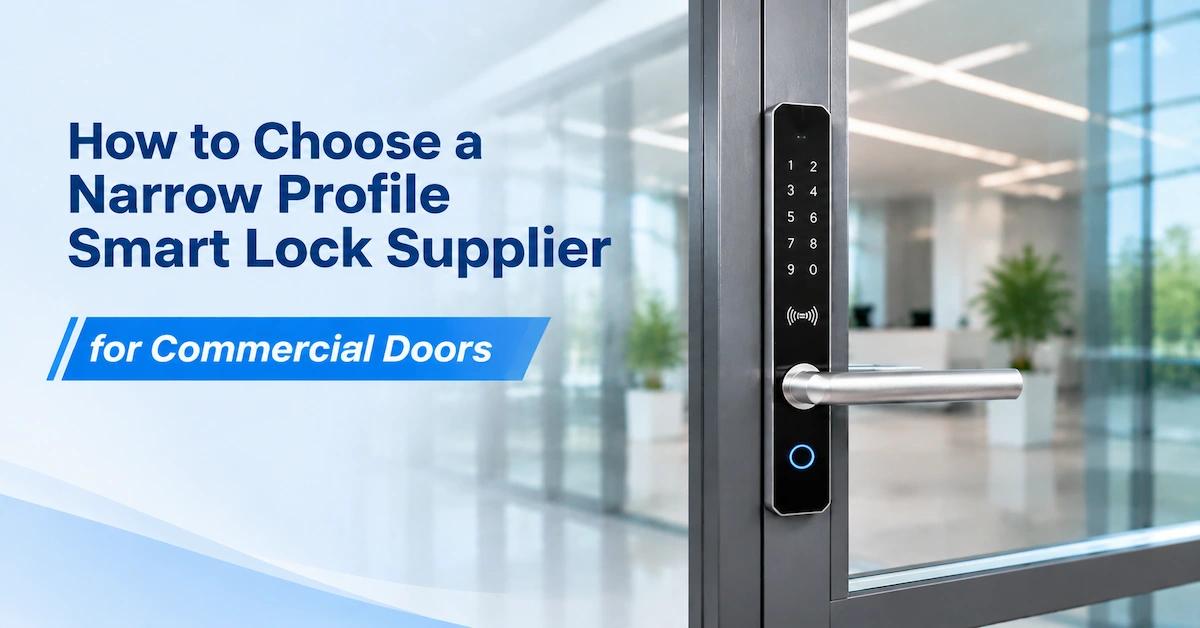
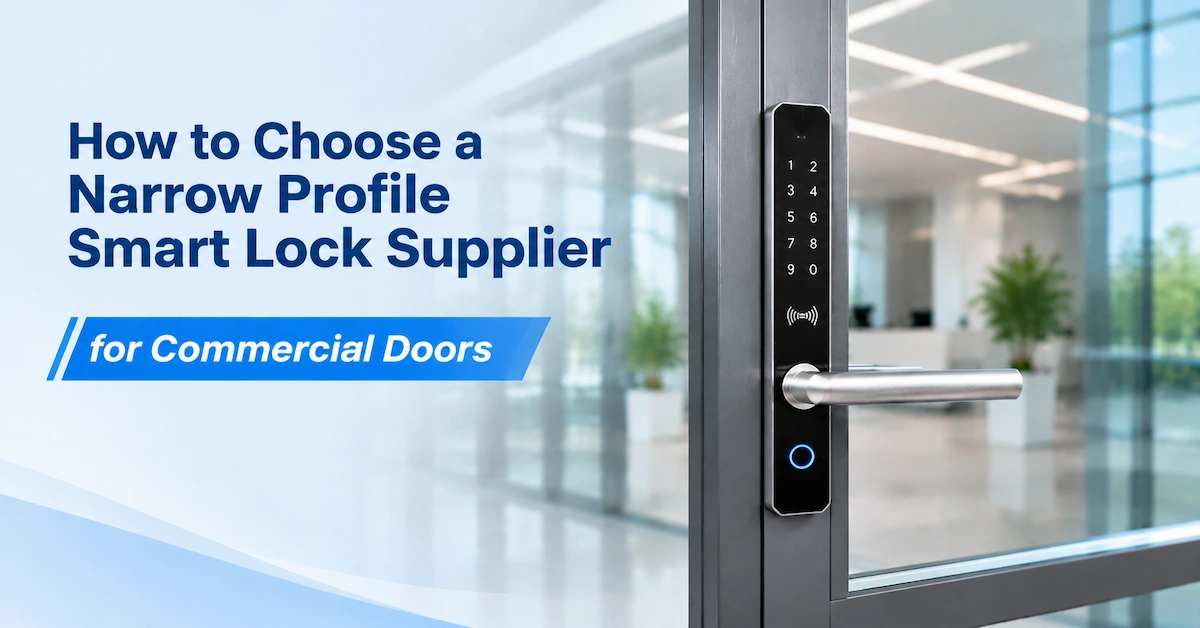
A standard smart-lock purchase often begins with the desired credential: fingerprint, PIN, card, mobile app or remote access. A narrow-frame project reverses that order. The available door section may be only a small part of the assembly, and the lock body, escutcheon, battery compartment, spindle, cylinder, strike and cable route must coexist inside it. A supplier that recommends a model from a product photo without requesting a dimensioned door schedule is asking the installer to absorb the compatibility risk.
The visible width is only one constraint
Record the stile or face width, but also record the usable depth, lock-center position, door thickness, frame rebate, glass relationship, handle position and clearance to the adjacent leaf. Sliding doors, thermal-break aluminum doors and narrow hinged doors can have similar external proportions while using different lock cases. A slim outside panel can still hide a lock body that is too deep, too long or incompatible with the existing preparation.
Door geometry varies across one project
Large projects rarely contain one perfectly repeatable opening. Office fit-outs may combine new aluminum doors with retained frames. Apartment projects may use several fabricators or construction phases. Retail portfolios may have different storefront systems in each location. Before finalizing a batch, survey representative doors from each profile, handing and hardware family. Use photographs to support the survey, but do not treat photographs as a substitute for millimeter measurements and drawings.
Smart access must not compromise egress
A narrow lock is still part of a life-safety and door-hardware system. Define the normal entry direction, free egress route, fire or emergency release requirement, mechanical override and the action required when batteries are low. The supplier can describe product behavior, but the project engineer and local authority must confirm whether the selected arrangement is suitable for the building and jurisdiction.
| Door input | What to measure or document | Why it changes the shortlist | Evidence to request |
|---|---|---|---|
| Profile and stile | Visible width, usable depth, frame rebate, adjacent clearance and whether the frame is aluminum, metal, uPVC or another system. | Determines whether the lock face and internal body can sit without collision or unsafe modification. | Dimensioned sketch, profile section, supplier fit comments and installation drawing. |
| Lock preparation | Mortise, hook, cylinder, spindle, backset, strike, existing cutout, screw centers and lock-center height. | Determines whether the electronic body can replace or work with the existing mechanism. | Lock-body drawing, compatible series list and approved sample configuration. |
| Door operation | Hinged or sliding, single or double leaf, handing, opening direction, self-closing force and daily cycle expectation. | Changes alignment, latch behavior, battery access and service requirements. | Opening schedule, cycle assumptions, alignment tolerance and commissioning method. |
| Environment | Indoor or outdoor position, rain, dust, salt, temperature, humidity, direct sun and cleaning chemicals. | Changes enclosure, material, finish, sealing and the practical meaning of an IP claim. | Model-specific environmental limits and installation exclusions. |
| Workflow | User groups, credentials, remote access, temporary access, offline behavior, audit events and emergency entry. | Determines platform, gateway, battery plan and administration effort. | Credential matrix, software boundary, data flow and failure-recovery procedure. |
What should a narrow profile smart lock supplier prove before quoting?
A supplier comparison should be evidence-led. The supplier does not need to provide every feature in one model, but it must show that its recommendation is based on the real opening and that its commercial offer can be controlled from sample to production. Ask for five proof sets: mechanical fit, electronics and credentials, operating environment, manufacturing control and lifecycle support.
Mechanical fit evidence
Request the exterior dimensions, lock-body dimensions, backset or mortise references, compatible door thickness, handing method, strike arrangement, fixing points and clearance requirements. If the supplier proposes customization, ask which part changes: faceplate, lock case, spindle, cylinder, mounting bracket, firmware, finish or packaging. Customization should be linked to a drawing revision and sample approval, not a vague promise that the model is "adjustable."
Credential and platform evidence
Confirm whether the selected model uses Tuya Smart, TT Lock or another platform, and whether the app is the primary operating layer or only one local credential option. Ask how administrators create and remove users, how temporary codes expire, how lost cards are revoked and what happens when the phone, gateway or internet connection is unavailable. A feature list that says "app control" does not answer these operational questions.
Manufacturing and quality evidence
For a distributor or brand, batch consistency matters as much as the first sample. The supplier should explain how the approved model, finish, firmware and accessory list are identified on the purchase order and how changes are communicated. Ask for inspection points covering appearance, lock operation, credential enrollment, battery behavior, emergency power and packaging. KEYPLUS describes its broader Manufacturing & Quality approach; the project should still request model-specific inspection documents for the final configuration.
Commercial and support evidence
Ask the supplier to separate sample price, production price, tooling or customization cost, packaging, shipping basis, lead time, warranty, spare parts and technical support. MOQ is not a universal attribute of a product page. It can change with finish, logo, packaging, software version and destination. A responsible supplier states the assumptions behind the quotation so a low headline price does not become an expensive change order.
When a narrow profile smart lock supplier cannot state those assumptions, the buyer should treat the quote as a preliminary budget rather than a purchase-ready offer. This distinction protects distributors and brands from selling a configuration that has not passed a door or software review.
| Supplier capability | Buyer question | Minimum evidence before approval |
|---|---|---|
| Door engineering | Can the supplier review a profile section and identify a compatible lock body rather than selecting by appearance? | Marked-up drawing, compatible dimensions, exclusions and a named technical owner. |
| Product architecture | Which credentials, apps, gateways, keys and emergency-power methods are available on the exact model? | Model-specific datasheet, credential matrix, software version and failure behavior. |
| Sample control | Will the sample match the production finish, firmware, mortise, packaging and accessory set? | Sample configuration sheet, revision number, photos and approval record. |
| Batch quality | How are changes, inspection results, defects and replacement units managed? | Inspection plan, change-control process, test record and support escalation path. |
| Commercial delivery | What exactly is included in the price and what assumptions affect MOQ or lead time? | Dated quotation with configuration, terms, delivery basis, warranty and exclusions. |
Which KEYPLUS narrow-profile models belong on a B2B shortlist?
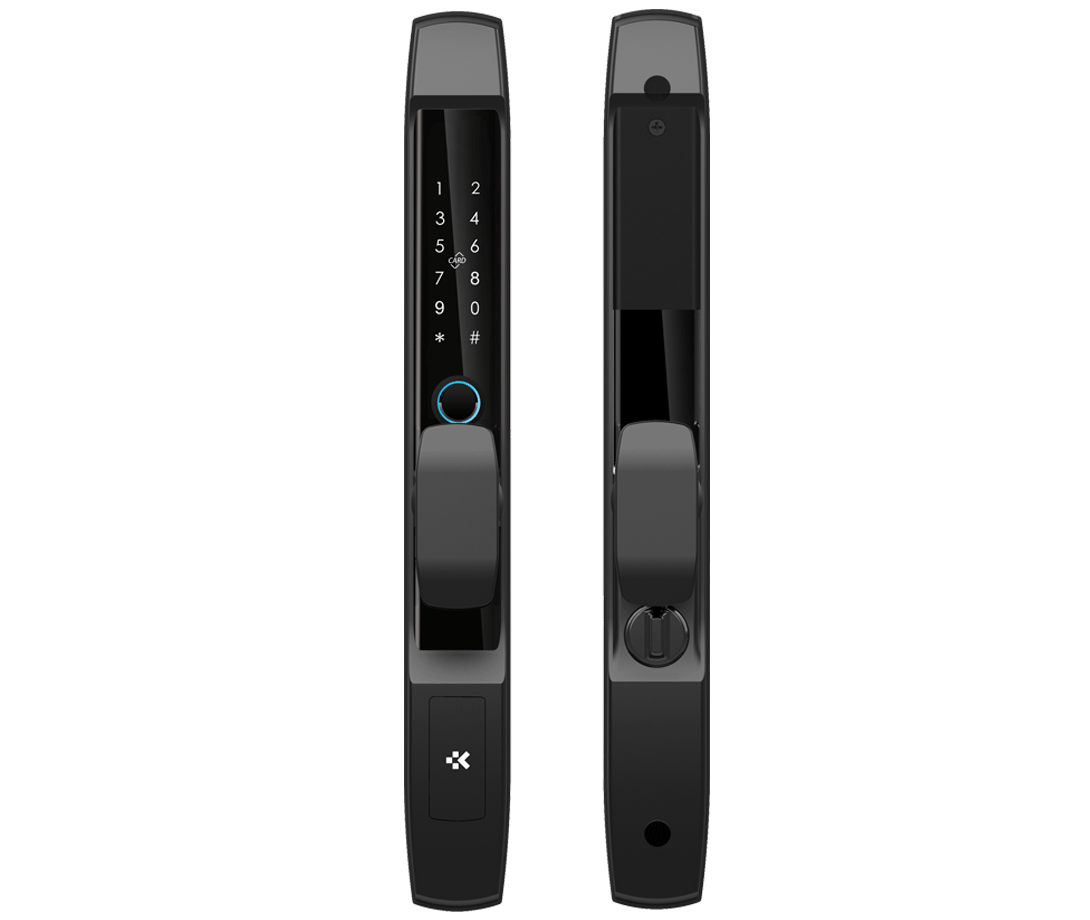
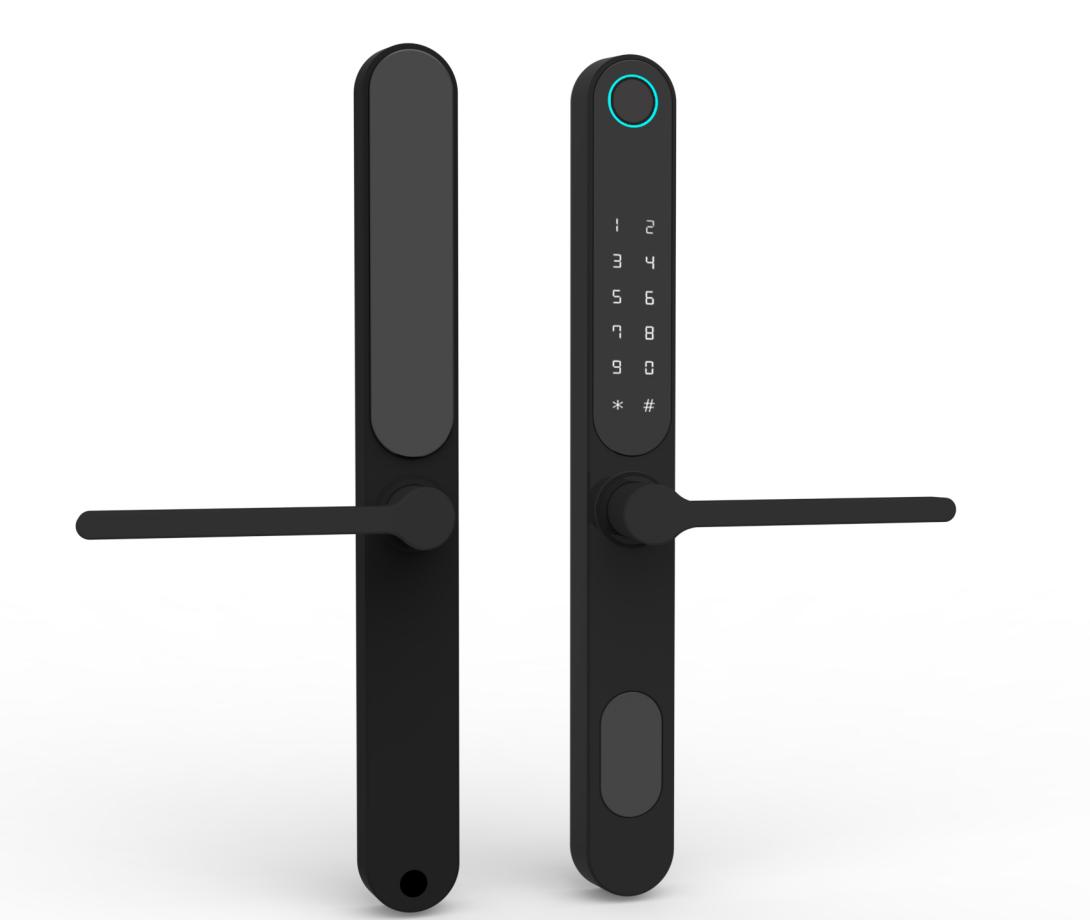
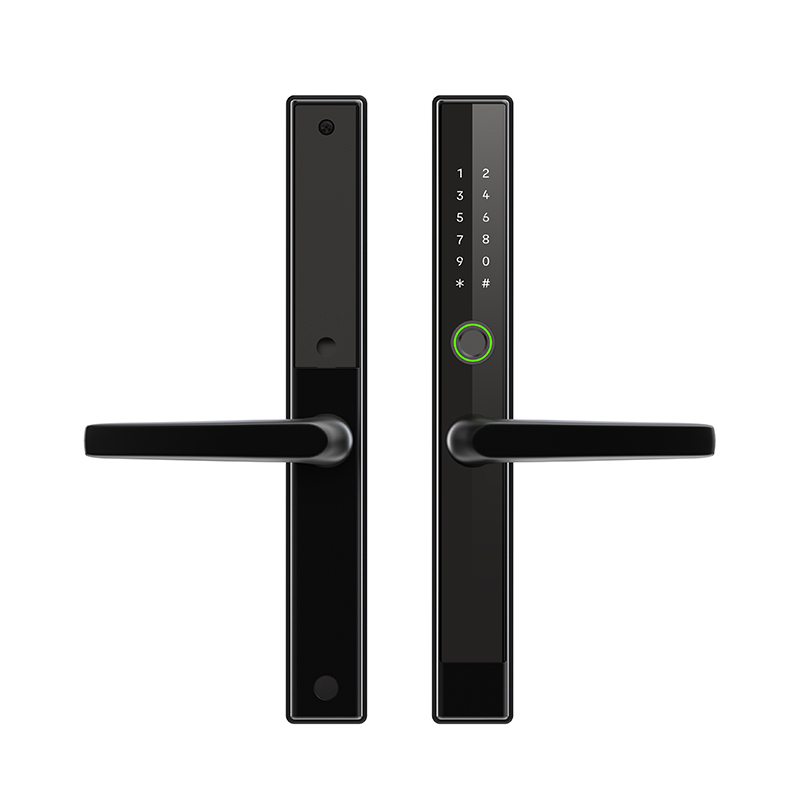
The published KEYPLUS category currently shows three narrow-profile models: T8, A01 and T5. They should be treated as starting points for a fit review, not as interchangeable products. The following comparison uses the public product pages and keeps project-dependent items visible. A facial or fingerprint feature, an IP rating or a user-capacity number cannot replace a door survey and sample test.
| Model | Publicly stated details | Potential project fit | Confirm before order |
|---|---|---|---|
| KEYPLUS T8 | Zinc-alloy build; TT Lock app listed; fingerprint, PIN, smart card, key fob and mechanical key carriers; IP65; 4 AAA batteries; 40-70 mm door-thickness range listed; up to 120 fingerprints, 200 cards and 150 passcodes listed. | Slim hinged or framed doors where a compact exterior, several local credentials and TT Lock management are appropriate. | Actual stile and lock-body clearance, mortise or cutout, app region, battery cycle assumptions, finish, emergency-power method and sample result. |
| KEYPLUS A01 | Designed for sliding and aluminum doors; fingerprint, password, smart card, Tuya app and mechanical key; IP65; 4 AAA batteries; 35-65 mm door-thickness range listed; shared capacity of 300 entries; black finish listed. | Aluminum or sliding-door projects needing a compact body, multiple credential paths and Tuya-oriented operation. | Sliding-door lock case, opening direction, frame clearance, local weather exposure, remote-control requirement, language, finish and production configuration. |
| KEYPLUS T5 | Space-aluminium build; Tuya and TT Lock options; fingerprint, card, PIN, key fob and mechanical key; IP65; 4 AAA batteries; 40-65 mm door-thickness range listed; 85, 72 and double-hook mortise references; 501 ordinary users plus 10 administrators listed. | Office, rental and multi-user projects where a narrow door format and broader local user capacity are useful. | Exact mortise series, hook alignment, door handing, weather exposure, platform ownership, user lifecycle, finish, warranty and acceptance criteria. |
The table is a shortlist, not an approval certificate. Public product pages describe capabilities, but they do not establish universal compatibility with every aluminum profile, local building code, access-control platform, mortise or project environment. If a buyer needs a different lock body, finish, logo, language, packaging or software boundary, put the request in the RFQ and require a revised drawing before production.
A narrow profile smart lock supplier should also explain which model is the fallback when the survey identifies a different lock preparation. A credible shortlist includes an alternative format or a documented reason why the opening should not use a narrow-profile lock.
How should buyers validate compatibility before a batch order?
The most expensive narrow-frame mistake is approving a sample that was never installed on a representative door. A desktop demonstration can prove that a fingerprint reads or an app command arrives; it cannot prove that the lock body clears the frame, that the latch aligns under real closing force or that every opening in the batch shares the same preparation.
Build a representative door pack
Send the supplier a door schedule, profile section, photos from the lock edge and interior face, door thickness, handing, backset, lock-center height, existing mortise or hook series, strike detail and opening direction. Mark the doors that are new, retained, sliding, double-leaf, exposed to weather or subject to high traffic. The more varied the project, the more important it is to define which doors the sample represents.
Install the sample with production intent
Use the intended installer, fasteners, strike, spacers, battery type, finish and platform version. Record drilling or cutout changes and whether the door still closes, latches and releases smoothly. Check the handle or pull action, key override, emergency power port, battery access and clearance to the adjacent frame. If a supplier asks the installer to improvise a bracket, record that as a design change rather than treating it as a normal installation.
Before a narrow profile smart lock supplier receives batch approval, the sample should be traceable to the same drawing revision, firmware family, finish and accessory list that will appear in the production order. Otherwise the pilot proves only that one specially prepared lock can work.
Test the workflow, not just the unlock event
Enroll an administrator and ordinary users, issue a temporary credential, revoke it, let a code expire, remove a card, replace a battery and perform an emergency-power action. Disconnect the network or gateway where the selected model uses one. Confirm what remains local, what is delayed and what is synchronized after recovery. For an apartment or office, test staff and contractor permissions separately from residents or employees. For hospitality, confirm whether the lock is being used for a room workflow or only as a local electronic lock.
| Acceptance area | Test scenario | Evidence to keep |
|---|---|---|
| Mechanical fit | Install on a representative profile; close, latch, unlock and release repeatedly; check frame clearance and alignment. | Installation photos, dimensions, cycle notes, adjustment record and approved drawing revision. |
| Credentials | Enroll and remove fingerprint, card, PIN, key fob, app user and mechanical override as applicable. | User matrix, event screenshots, failure cases and operator instructions. |
| Power | Observe low-battery warning, replace batteries, use emergency power and verify recovery after restart. | Battery type, measured behavior, recovery time and maintenance procedure. |
| Connectivity | Test normal communication, gateway or app loss, local operation, reconnection and event synchronization. | Network condition, expected behavior, event record and software version. |
| Environment | Use the intended entrance conditions and inspect sealing, finish, keypad or reader behavior and cleaning method. | Site condition, model limit, inspection photos and exclusions. |
| Batch readiness | Compare the approved sample with pre-production or first-batch units, including finish, accessories and packaging. | Golden sample record, inspection checklist, change notice and release approval. |
What credentials and connectivity should a supplier support?
Credential choice should follow the operating team, not the marketing headline. A distributor may want one model family that can be positioned for apartments, offices and small commercial properties. A system integrator may need a predictable local credential with a separate management layer. A brand may prioritize app ownership, language, packaging and support. The supplier should make those trade-offs explicit.
Local credentials and remote administration serve different jobs
Fingerprint, PIN, card, key fob and mechanical key can provide local entry without asking every user to carry a phone. Tuya or TT Lock can support app-based control and access sharing on the listed models, but the project still needs to define who controls the account, how users are transferred between properties, how lost phones are handled and whether the app is acceptable for the target market. Do not assume that a shared app account is an enterprise access policy.
Offline behavior must be written down
A battery lock can continue to open locally while the network, phone or gateway is unavailable, but the exact behavior varies by model and configuration. Ask whether permissions, schedules and events remain on the lock, whether a revoked user can still enter during an outage, how time is maintained and how records synchronize afterward. The correct answer belongs in the commissioning and support documents, not only in a sales conversation.
Connect to the wider access strategy when needed
Some projects need a smart lock as a relatively independent opening. Others need a consistent identity policy across doors, elevators, visitor processes or building operations. The KEYPLUS Access & Identity system provides the wider context for identity, credentials, passage and event workflows. Confirm the exact integration boundary before promising that a narrow-profile lock will behave like a hardwired access-control reader or a hotel PMS lock.
How should a buyer compare supplier promises about materials and IP ratings?
Material and IP language is useful only when tied to the exact model, finish and installation. KEYPLUS product pages list zinc alloy for T8, a space-aluminium build for T5 and a slim aluminum-door design for A01. Those statements help create a shortlist, but they do not answer whether a finish is suitable for a coastal location, whether a gasket is installed correctly, or how a cleaning chemical affects a keypad and coating.
Ask what the material statement means in the assembly
Clarify which visible parts are zinc alloy, space aluminum, stainless steel, plastic or another material, and which parts carry the mechanical load. Ask about the lock body, strike, fasteners, spindle or hook, battery cover and mounting plate. For a brand or wholesaler, request the material and finish record that belongs to the approved configuration so a visually similar replacement is not shipped later.
Treat IP65 as a condition, not a blanket guarantee
IP65 can be a useful published reference, but the practical result depends on the complete installation, orientation, cable or emergency-power opening, door exposure and maintenance. Do not use an IP rating to avoid a site assessment. Confirm whether the proposed model is intended for fully exposed, semi-outdoor or indoor use, and what exclusions apply to the finish and electronics.
Ask about battery and maintenance ownership
Battery life depends on unlock frequency, temperature, credential method, motor load, alignment and battery quality. A supplier should provide a maintenance method rather than an attractive cycle number alone. Define who replaces batteries, where spares are held, how low-power alarms are reported and how a property team gains emergency access without creating an untracked bypass.
What should be included in a narrow profile smart lock RFQ?
A good RFQ makes suppliers quote the same problem. It gives them the door information, operating workflow and commercial scope needed to return a comparable proposal. It also protects the buyer from a common failure mode: receiving a low price for a lock that fits a different door, uses a different app or excludes the accessories needed for installation.
Ask every narrow profile smart lock supplier to return the model, drawing, assumptions, exclusions and commercial basis in the same order as the RFQ. Side-by-side comparison becomes possible only when the suppliers answer the same technical questions.
| RFQ section | Buyer should provide | Supplier should return |
|---|---|---|
| Door schedule | Quantity by profile, photos, dimensions, thickness, handing, sliding or hinged operation, lock preparation and exposure. | Recommended model by door group, fit assumptions, drawing, exclusions and required accessories. |
| Access workflow | User groups, credentials, temporary access, revocation, emergency entry, app or gateway preference and audit needs. | Credential matrix, platform boundary, offline behavior, administrator roles and user limits. |
| Sample and pilot | Representative door, installation date, test users, installer, acceptance criteria and approval owner. | Sample configuration, preparation time, test support, evidence format and change-control process. |
| Commercial scope | Quantity, finish, logo, packaging, destination, documentation, spare units and training expectation. | MOQ, sample and batch pricing, tooling or customization, delivery basis, warranty and support terms. |
| Quality release | Inspection points, golden sample, defect reporting, replacement process and batch approval. | Inspection plan, test record, packaging standard, change notice and escalation contact. |
Narrow-profile smart lock RFQ checklist
- Door profile width, usable depth and frame section
- Door thickness, handing, opening direction and lock-center height
- Mortise, hook, cylinder, spindle, backset and strike details
- Hinged, sliding, single-leaf or double-leaf operation
- Indoor, semi-outdoor or fully exposed installation conditions
- Fingerprint, PIN, card, key fob, app and mechanical-key requirements
- Administrator, resident, employee, visitor and contractor roles
- Battery, emergency power, offline and event-synchronization behavior
- Sample door, installer, pilot schedule and acceptance owner
- MOQ, packaging, finish, logo, delivery, warranty and spare-parts terms
Use the KEYPLUS RFQ route for a model-specific review. Include the door schedule and photos, then ask the supplier to connect the recommended narrow-profile model to the Smart Locks portfolio and the relevant operating workflow. A buyer can also compare project scenarios such as office, rental apartment and hotel deployments before choosing one lock family for the whole schedule.
Frequently asked questions about narrow profile smart lock suppliers
What should a narrow profile smart lock supplier receive before quoting?
Send a door schedule, profile section, lock-edge and interior photos, door thickness, handing, opening direction, lock preparation, strike, environment, quantity, credential workflow and sample requirement. If a supplier receives only a product photo or the phrase "slim aluminum door," it cannot reliably select the lock body, strike or accessories.
Is a narrow-profile smart lock the same as a standard smart lock?
No. A narrow-profile lock is designed around restricted stile or frame space, so the mechanical body and installation clearances are central to the decision. A standard escutcheon may have the right credential features but still be too wide, too deep or incompatible with the door preparation.
Which KEYPLUS models are listed for narrow-profile doors?
The current KEYPLUS Narrow Profile Door Locks category lists T8, A01 and T5. T8, A01 and T5 have different public descriptions for materials, door types, platforms, capacities and compatibility references. Use the category as a shortlist, then confirm the exact model and configuration against the door survey.
Can a narrow-profile lock be used on an aluminum sliding door?
Some models are positioned for sliding or aluminum doors, including A01, but compatibility depends on the sliding-door lock case, frame section, door thickness, travel, strike or hook arrangement and clearance. Require a drawing review and representative installation rather than assuming that every aluminum door shares the same preparation.
What credentials should a commercial buyer specify?
Specify the user groups and operating task first. Fingerprint, PIN, card, key fob, app and mechanical key can serve different roles. The RFQ should define enrollment, revocation, temporary access, lost credentials, emergency entry and the administrator responsible for each method.
Do Tuya and TT Lock mean the same thing for a project?
No. They are different platform choices and may imply different account ownership, workflows, integrations, languages and support responsibilities. Confirm which platform applies to the exact model, whether a gateway is required, who owns the account and what happens during an outage or user transfer.
How should a supplier prove a narrow lock will fit a project?
The supplier should return a marked-up door drawing, model and accessory list, compatibility assumptions, installation constraints and a sample plan. Approval should follow an installation on a representative opening. A catalogue image, nominal door-thickness range or verbal statement is not enough for a multi-door project.
For a high-volume order, require the narrow profile smart lock supplier to identify the approved drawing revision and the person responsible for fit questions during installation. This keeps a late door-profile change from becoming an undocumented field modification.
What should be tested in a smart-lock sample?
Test mechanical alignment, latching, credentials, app or gateway behavior, temporary access, revocation, low battery warning, emergency power, mechanical override, network loss, recovery, user capacity and finish. Compare the sample with the intended production specification and keep the approved configuration as the golden sample.
Should a buyer ask for MOQ and lead time in the first inquiry?
Yes, but ask for them against the exact configuration. Finish, logo, packaging, tooling, platform version, quantity and destination can change the commercial basis. A useful quotation states the validity, delivery basis, warranty, included accessories and any assumptions instead of presenting one generic MOQ or lead time.
When should a buyer choose another lock format instead?
Consider a lever, glass-door, rim, deadbolt, handle, electronic-cylinder or hardwired access-control format when the opening does not match the narrow lock body, when the project requires a different egress behavior, or when the identity system needs an interface the selected lock does not provide. The Smart Locks portfolio is organized by door construction and workflow so the supplier can compare alternatives instead of forcing a narrow model into an unsuitable opening.
Conclusion
A narrow profile smart lock supplier should be selected on evidence, not on the smallest-looking exterior or the longest feature list. The buyer needs a dimensioned door review, a model-specific lock-body recommendation, a clear credential and platform boundary, a representative sample installation, a batch-quality plan and a dated commercial quotation that states MOQ, delivery, warranty and support assumptions.
For a project that spans multiple door profiles, the narrow profile smart lock supplier must keep the approved model and installation assumptions visible from pilot through final shipment.
KEYPLUS provides a focused T8, A01 and T5 shortlist within its Narrow Profile Door Locks category, while the wider Smart Locks portfolio allows an alternative format to be considered when the opening or workflow changes. Send the door schedule, profile drawings and operating requirements before ordering so the supplier can recommend the right model, document the sample and support a repeatable project rollout.