
Monitor environmental quality
Use suitable temperature, humidity, CO₂, air-quality, light, noise and other environmental sensors to understand selected space conditions within documented ranges and placement rules.
KEYPLUS · Systems
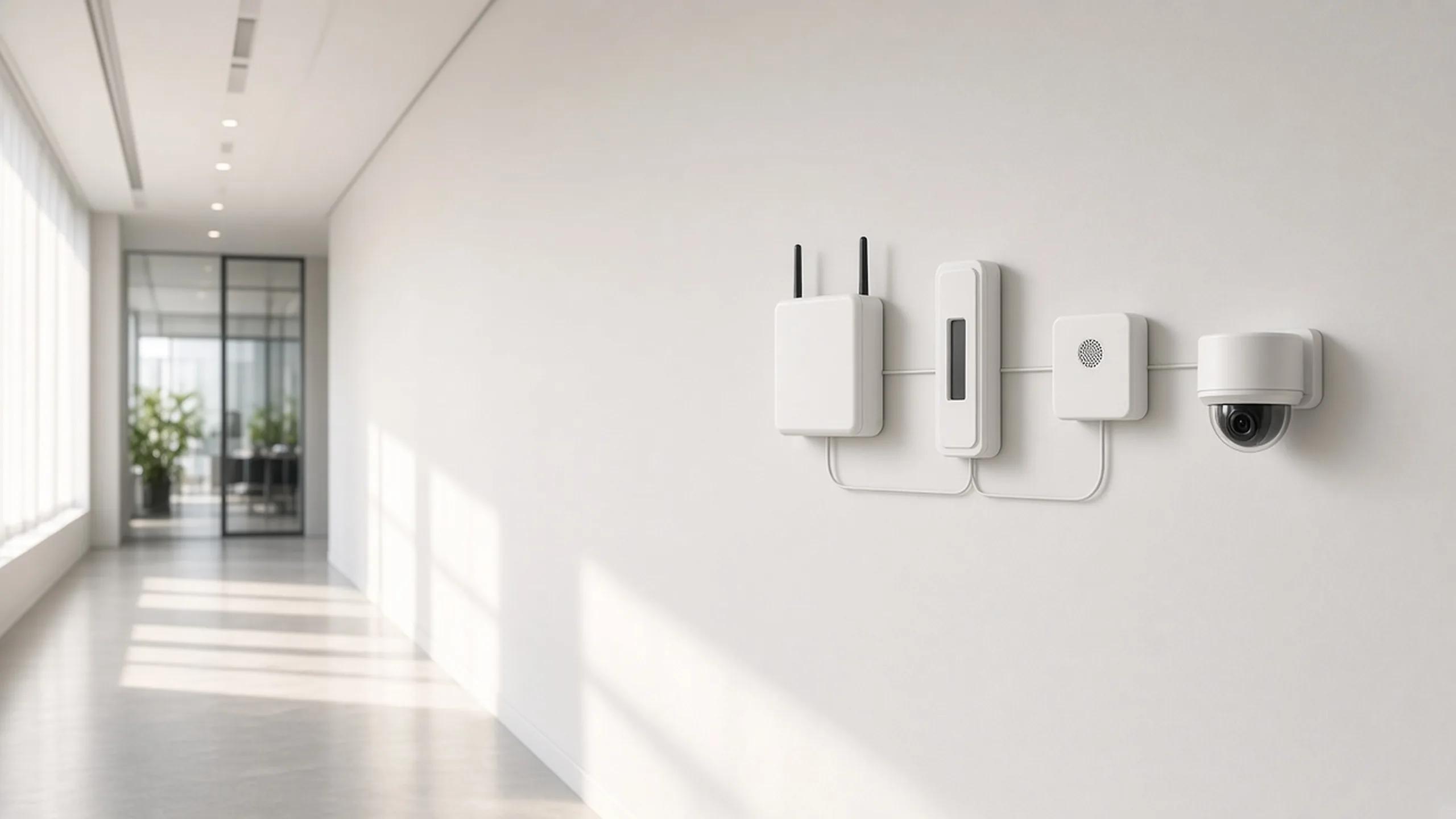
Detect conditions across rooms, buildings and equipment, then connect approved responses through gateways and controllers. KEYPLUS brings environmental sensing, occupancy awareness, safety-related detection, device status and bounded control into one engineered system with clear local behavior and platform context.
A sensor is useful only when its purpose, location, range, placement, maintenance and response are defined. A detected state does not always prove the cause, and a control command does not prove that the physical outcome occurred. Critical protection functions must remain safe and locally authoritative if a gateway, network or wider platform becomes unavailable.
Use suitable temperature, humidity, CO₂, air-quality, light, noise and other environmental sensors to understand selected space conditions within documented ranges and placement rules.
Use occupancy, motion, human-presence, door, window and equipment-state sensors to support room modes, service workflows and space awareness without assuming that every signal identifies a person.
Connect suitable water-leak, liquid-level, combustible-gas, smoke, heat or approved panel signals to defined notification and response workflows. Certified fire and gas protection systems retain their required local functions and authority.
Apply bounded commands through room or zone controllers, relays, dimmers, thermostats, fans, valves, curtain controls or equipment interfaces, with manual override and safety interlocks where required.
Define local rules, offline behavior and state reconciliation. Monitor available battery, communication, calibration, tamper and fault information so teams can prioritize inspection and maintenance.
The system can combine wired and wireless sensors, local inputs, room or zone controllers, gateways, actuators and platform interfaces. Device selection must consider detection principle, range, accuracy, response time, placement, power, battery life, interference, sampling interval, actuator rating, environmental certification and firmware support. Monitoring access and control authority remain separate.
Rules can evaluate known thresholds and combinations; analytics can reveal recurring environmental changes, nuisance alerts or device degradation; AI assistance can help prioritize inspection when supported by representative history. An analytical result remains an indication for review and does not override a certified detector, protection panel or responsible person.
A supported leak, combustible-gas, presence or environmental sensor reports a condition
the local system preserves any required protective behavior
the gateway adds device and location context
the event is prioritized and routed
an approved local action or staff task is initiated where permitted
device feedback, a follow-up reading and human verification provide closure evidence.
Survey each sensing environment, select the correct detection method and rating, validate placement and representative conditions, define calibration and replacement intervals, confirm network and battery expectations, and test false or missing signals, communication loss, manual override, actuator fail-safe behavior, acknowledgement and physical response. Life-safety devices and interfaces require their own qualified design and acceptance process.
Guest rooms, rental units, classrooms, meeting rooms, retail spaces, kitchens, plant rooms, utility areas and approved non-clinical hospital spaces require different sensor combinations, thresholds, privacy controls and response procedures.
No. Required protection systems remain independently designed, certified and authoritative; an approved interface may share selected status for wider response.
Not necessarily. Many presence and occupancy technologies indicate state without identifying an individual.
No. The response depends on risk, evidence, permissions, local safety logic and the required human review.
Share the site type, operating responsibility, approximate scale, existing equipment, required interfaces and the event or action the system must handle.